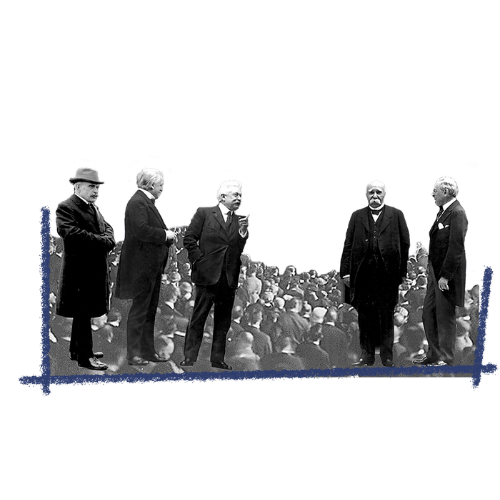
More than 100 years ago, the negotiations for the Treaty of Versailles were under way at the Paris Peace Conference. Lasting 6 months and involving 32 countries and territories, the Paris Peace Conference and its resulting treaty have always been controversial. According to some historians, the punitive clauses of the Treaty of Versailles may have contributed to the outbreak of the Second World War. How do we teach this difficult and controversial document to our students? This historical role-playing game lets students come up with their own conclusion to the war while demonstrating the difficulties of diplomatic negotiation and teaching about the conflicting hopes and expectations that shaped this important document.
To complete this activity, it is recommended that students have a foundational knowledge of WWI. Our virtual exhibition Mobilizing a Country is a great place to start.
Activity overview
The activity is led in class by the teacher using the teacher’s guide. Each group of students receives a character sheet, from the character booklets, and is asked to play the role of one of the heads of state described and to present their country’s interests. The outline helps to structure the session by asking the students questions, getting them to debate their positions, and encouraging them to propose solutions. At the end of the activity, the students will have drafted their own version of the Treaty of Versailles.
Curriculum connections
This activity was designed as an educational tool for educators teaching Ontario’s Grade 10 history course, Canadian History since World War I and can help teach the following specific expectations:
A1.5 Use the concepts of historical thinking (i.e., historical significance, cause and consequence,
continuity and change, and historical perspective) when analysing, evaluating evidence about, and formulating conclusions and/or judgements regarding historical issues, events, and/or
developments in Canada since 1914
B1.4 Explain the impact on Canadian society and politics of some key events and/or developments during World War I
B2.2 Analyse, with reference to specific events or issues, the significance of and perspectives on Canada’s participation in international relations between 1914 and 1929