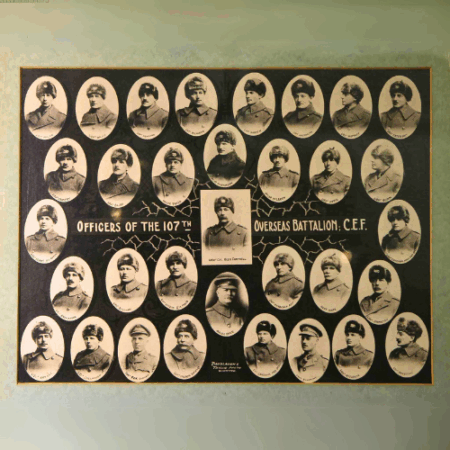
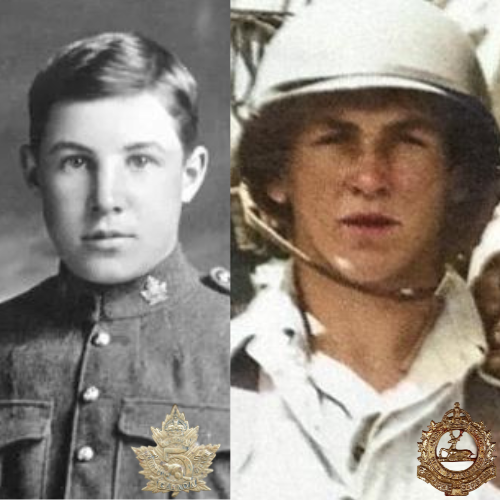
Throughout history young men and women have stepped forward to answer their country’s call. In an unfortunate number of conflicts both past and present, very young children have been used as foot soldiers. For Canada, however, in both world wars, there were clear rules about who could join the military as combatants. They had to be male, over the age of 18, and had to meet certain physical parameters of height, weight and health. This was in a period where it was not uncommon for young men to leave home at sixteen for full-time employment in industries far from home. For example, sixteen-year-old boys from 1930s New Brunswick often left home to work the lumber camps of Northern Ontario. It was also an era when many people did not have government documentation to show their birthdays. Infamously, during the First World War, Captain John Hensley enlisted at the age of 16 and died at 18 having been in command of over 200 men.
During WWI, if discovered, these teenagers were not usually returned to Canada but kept overseas for their usefulness until they came of age. They served in training units, service battalions, and the Canadian Forestry Corps (CFC). By December 1916, the 34th Battalion had over 800 underage soldiers in it. This helped to create the idea of ‘Boys’ Battalions, that would be formalized with the creation of Young Soldiers Battalions (YSB) in July of 1917. The presence of underage enlistees was not confined to the Great War.
In 1914 a wave of patriotic enthusiasm swept Canada and young men with heads full of stories of past imperial glory rushed to join the colours. Canadian Military Historian, Tim Cook estimated that upwards of 20,000 Canadians enlisted underage. The youngest known Canadian war dead of the 1914-1918 conflict was Private Clifford Oulton 832241. Born December 2, 1901, Clifford was the son of George and Dora from Bridgedale, NB. It is not known exactly why he chose to enlist on February 1st, 1916. It may have been for adventure, it may have been for the money, it may have been due to a conflict with his new stepfather, or it could have simply been because everyone else was doing it. Whatever the reason, he managed to convince the recruiter for the 145 Overseas (New Brunswick) Canadian Expeditionary Force (CEF), Harry K Jack, that he was 18. His payroll assignment indicates that he was sending his mother Dora Hyslop nee Chapman $20 per month. This would suggest that she had remarried after the death of his father in 1912 and knew where Clifford was. On September 25, 1916, Oulton embarked on the SS Tuscania for the United Kingdom. Nothing in his file indicates suspicion about his age.
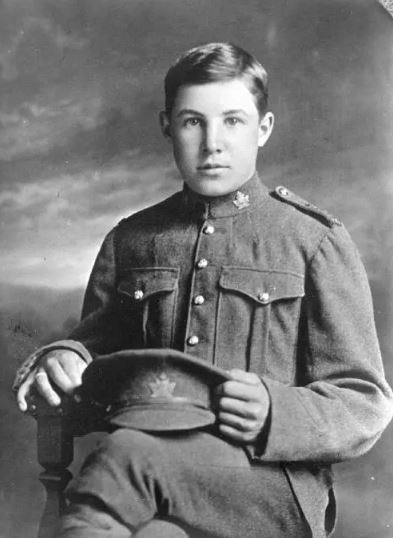
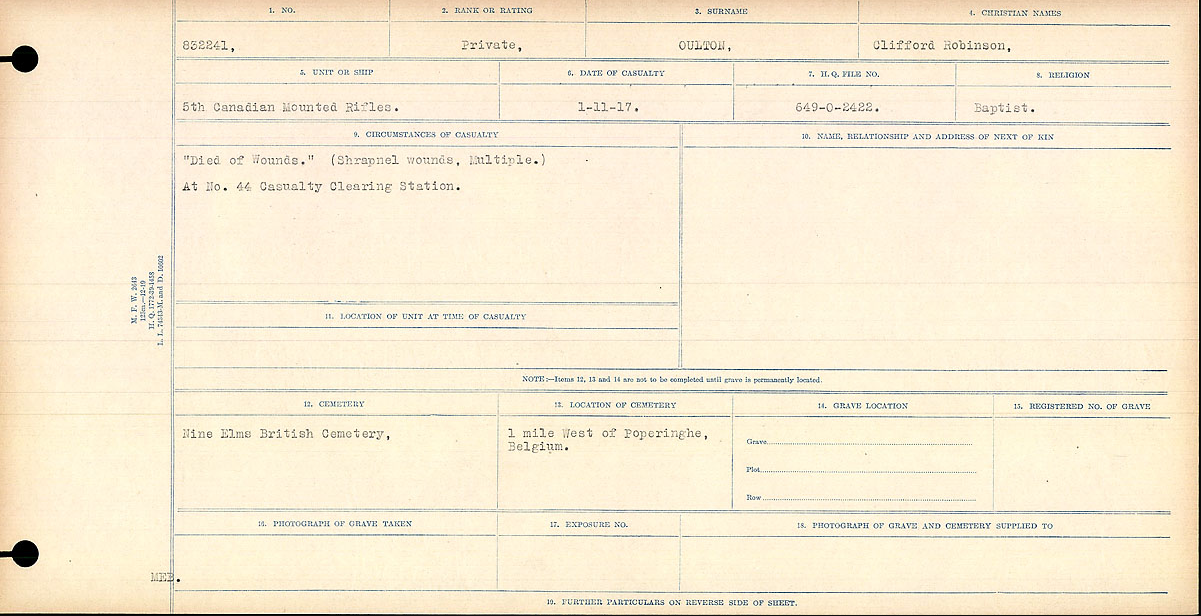
At this point in the war, the decision had been made by the government that fresh units arriving from Canada would be used to provide replacements in existing units already in combat. As a result of this policy, Clifford was assigned to the 5th Canadian Mounted Rifles (5CMR) on October 27, 1916. He would spend the next year in the trenches with his unit. The 5CMR was in the thick of the action. Clifford would have been at the Battle of Ancre Heights, Vimy Ridge and Arras, Hill 70, 3rd Battle of Ypres and finally in the muddy fields of Passchendaele. During Passchendaele, the 5CMR suffered a casualty rate of over 60%. Clifford was one of them. His Circumstances of Death Card indicates that he received multiple shrapnel wounds on November 1, 1917. They were able to evacuate him from the trenches and get him back to the Casualty Clearing Station, but he unfortunately succumbed to his wounds. As was the custom of that time, his mother received his memorial plaque, memorial cross and his medals. She also provided a personalized inscription for his grave marker: “He Died for God, King and Country”. He was only 15 years, 334 days old.
In the Second World War, documentation of age was not much better. The decision was made at the conclusion of hostilities to concentrate the bodies of the Canadian war dead who had often been hastily buried. It was felt that those whose bodies had been interred in Germany would not receive the proper care and respect over time. This reburial policy created one of the largest Canadian Commonwealth War Graves cemeteries, which was located in Groesbeek in the Netherlands.
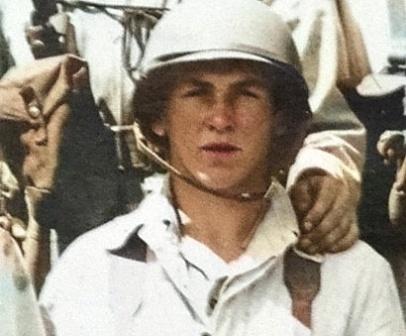
The youngest soldier to be buried there is Private Barney Rueben McGuigan F/82574 with the North Shore (New Brunswick) Regiment (NSR). Hailing from PEI, McGuigan enlisted in the Army on July 9th, 1943, claiming he had finished Grade 7 at 16 in 1941. He was noted as 5’7” with a light strong build. He had enlisted at Aldershot, NS and wanted to be either an RCA gunner or anti-tanker. He was repeatedly interviewed and was able to convince a number of officers of his age and maturity, although he had been born May 29, 1929 and was, in fact, barely 14 years old. Barney clearly indicated his father’s proper address and that his mother was deceased. His file mentions a few minor infractions regarding absences during training but nothing serious. He assigned $20 per month to his foster mother/grandmother Rose McGuigan.
Having completed basic training, he arrived in the United Kingdom on November 26, 1944, and was sent to join the NSR on February 12, 1945. The NSR had been one of the lead units of the Normandy landings. As a matter of fact, the famous footage of Canadians landing that day is of this regiment. As part of the Canadian Army, they had fought their way up the coast of France and into Holland. In February, they were pushing their way into the Reichswald Forest and advancing towards the industrial heart of Germany, the Rhineland.
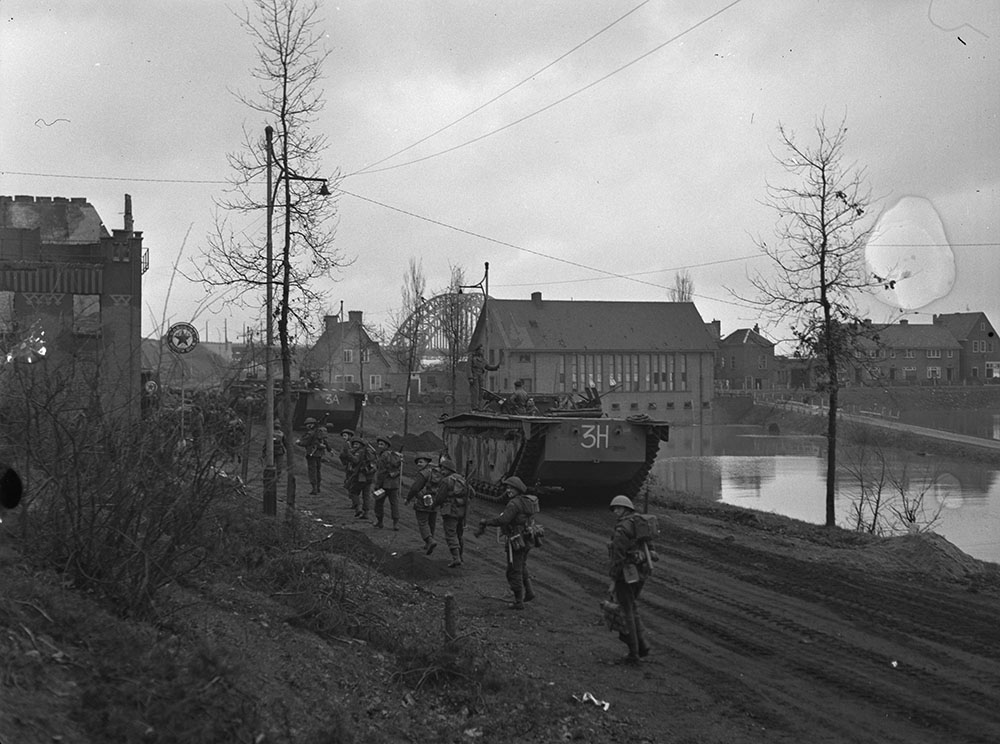
On the 12th the NSR was already suffering casualties and heavily involved in Operation Veritable. This battle continued until March 11th. Barney’s war, however, was over well before that. On February 26th, fourteen days after he joined the NSR, he was reported as Killed in Action. The details of his death are not recorded. He was 15 years and 273 days old. In his service file there is a letter from his father demanding to know why his son was sent to Europe to fight without his permission especially when there were able men of age available. It would appear his concerns were never formally addressed. Barney’s tombstone is inscribed “Died for the honour of his king and country. RIP.” If you look at the list of names from the Groesbeek Cemetery, there are three seventeen-year-olds: Bruno Boutet, Herbert Danielson and Ralph Ash, as well as a long list of 18 and 19 year-olds. A number of young Canadians gave their lives in the Netherlands.
As we reflect on the past, we need to remember these stories. These boys are the ones we can identify. War has always consumed our youth. We can never know the lost potential these young men could have realized.
Guest written by Kris Tozer for Honouring Bravery
Sources
McGuigan, Barney Ruben, Archives of Canada.