There is a cultural mystique around America’s war in Vietnam. For many, the whoop-whoop of Huey helicopters invokes the image of it hovering over a small jungle clearing that has become a landing zone (LZ). We can imagine khaki-clad soldiers leaping to the ground and dispersing under the clatter of small-arms fire and the boom of mortar shells. Or perhaps we imagine helmeted men quietly and cautiously moving through thick jungle undergrowth looking for the Viet Cong (VC) or ‘Charlie’. We can see the famous images of jets screaming overhead and dropping napalm onto hillsides. Scenes flood in from any number of movies about the experience: Forrest Gump, Apocalypse Now, Platoon, Full Metal Jacket and more. The Vietnam War defined a generation and an era in US history. For most Canadians, however, the Vietnam War is just a movie, a distant American conflict. But for the over 20,000 Canadians who enlisted, it is far more.
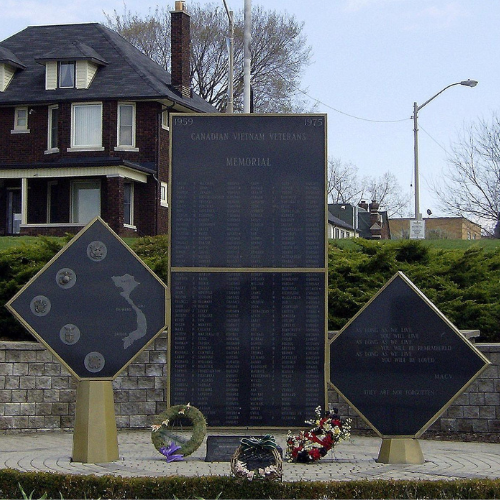
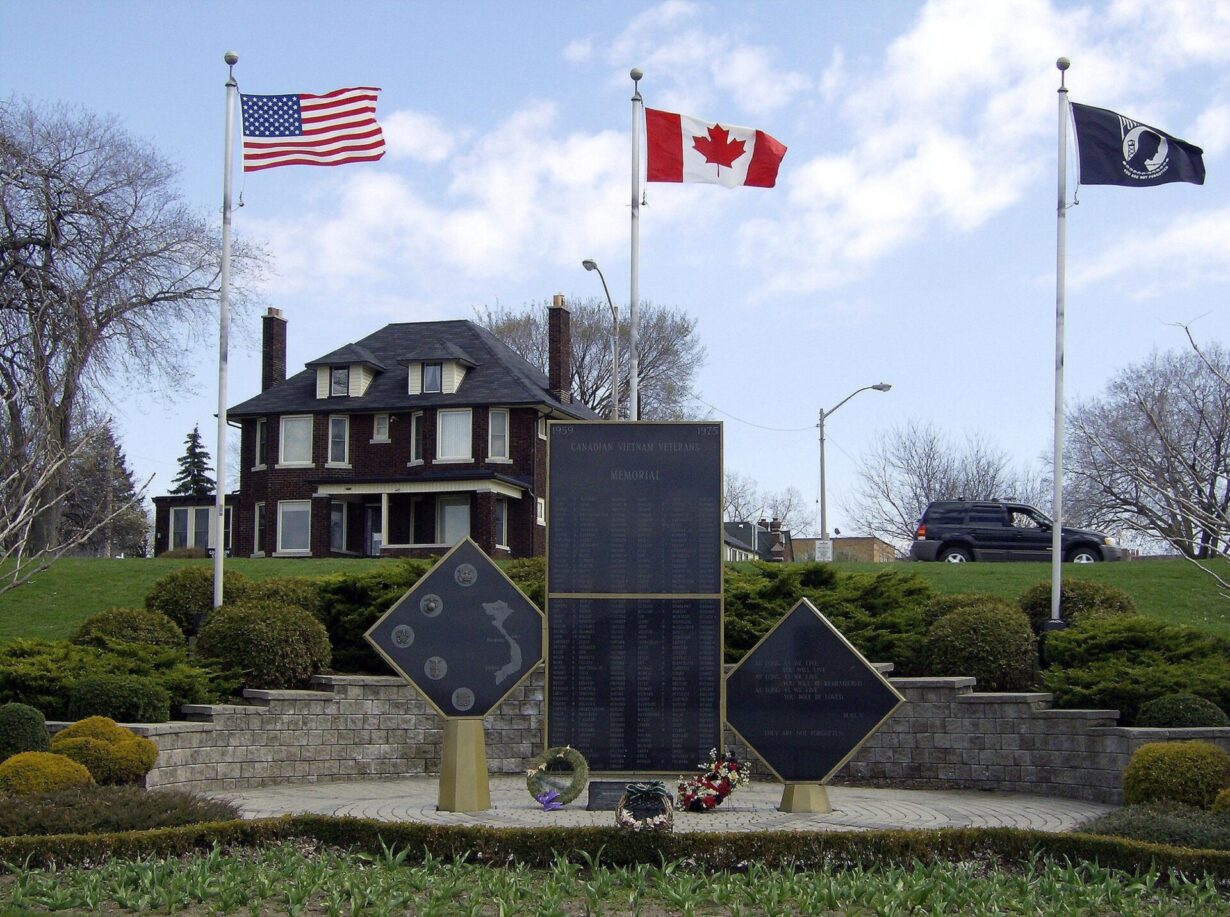
In Windsor, Ontario, there is a unique war memorial. It is not for Canadian military dead, and it was not erected by the Canadian government. On it are the names of 173 Canadians who died fighting in Vietnam. It carries the inscription. “As long as we live, you shall live. As long as we live, you shall be remembered. As long as we live, you shall be loved.” A similar monument to these same Canadians can also be found in Melocheville, Québec. Canada was not officially involved in the protracted conflict in Vietnam. During this factious period of Vietnamese history, our country deployed 2000 personnel in noncombat roles as part of both the International Commission for Supervision and Control (ICSC) 1954-1973 and the International Commission of Control and Supervision (ICCS) 1973-1975. That commitment came at the cost of five lives. During this period, over 25,000 American men came north to Canada to escape the draft. Just as Canadians have done since the US Civil War, however, some young Canadian men also journeyed south to join the fight in Vietnam, motivated by a sense of duty, ideology or adventure. It is estimated that between 20,000 and 40,000 Canadians served under the American flag.
The territory now known as Vietnam was colonized by the French starting in 1858 and was integrated into French Indochina, along with Laos and Cambodia, in 1887. It was occupied by the Imperial Japanese Army from 1940 to 1945. The Japanese occupation was a period of great hardship. Disease and repeated large-scale, man-made famines led to the deaths of millions. For different reasons, both Vichy France and Imperial Japan had encouraged the growth of Vietnamese nationalism. With the end of the Second World War in August 1945, there was a power vacuum in the territory, and the Marxist-Leninist leader, Ho Chi Minh, emerged as the effective leader of the newly declared Democratic Republic of Vietnam (DRVN). This transition was opposed by anti-communist Vietnamese, Nationalist Chinese and British forces, and, ultimately, French troops. France worked to reassert their control of the colony, triggering a long period of civil disorder and violence. After the defeat of the French Foreign Legion at the Dien Bien Phu, the 1954 Geneva Agreement was negotiated between the DRVN and France with the promise of free elections in 1956. This agreement divided the territory along the 17th parallel, creating the southern Republic of Vietnam (RVN). With no clear understanding or agreement on how the elections would be carried out and with North Vietnamese troops supporting dissidents in the south, the US government began to actively support the RVN. This support was in line with the Domino Theory prevalent at the time, which held that if one nation fell to communism, neighbouring countries would follow suit. Initially relying on South Vietnamese troops with US advisors, increasing instability led to an escalation of US involvement under Presidents Kennedy and Johnson. Between 1964 and 1973, the Americans committed over 160 billion dollars and 2.7 million personnel to the war effort. During the conflict 58,281 US soldiers were killed or went missing. While estimations vary, it is likely that nearly 2 million Vietnamese, both civilians and soldiers, were killed during the US War in Vietnam.
There is no complete record of Canadians who chose to fight under the Stars and Stripes. Historically, the border between our two nations has been porous and people have moved back and forth easily. When enlisting, men often lied about where they were born or simply listed the city they volunteered in as their residence, making the true number of enlisted Canadians hard to assess. Senator Edward Kennedy estimated that 40,000 Canadians joined the fight. A short blog like this could not possibly explore all the men who committed themselves to the effort. However, we can try to tell a few of their stories.
Richard Dextraze was born to Jacques Dextraze and Frances Pare in Ottawa. His father was a career officer in the Canadian Armed Forces, who later became a Major General. Enlisting on December 13, 1967, Richard joined the US Marine Corps. After completing his basic training, he arrived in Vietnam on June 17, 1968 and was assigned to Company E, 2nd Battalion, 9th Marines, 3rd MARDIV as a radioman. On September 11 of that year, he was involved in an action against entrenched members of the People’s Army of Vietnam (PNVA) in Huong Hoa District. The PNVA used claymore mines and small arms fire in this skirmish, and Dextraze and another marine were wounded. After recuperating, he returned to his unit on November 27th as a scout. In April, acting in this role, he searched for signs of enemy activity around Dong Kio Mountain in the Quang Tri Province. His unit made contact with PNVA soldiers in dug-in concealed fortifications. With heavy machine-gun fire and dense foliage, it was impossible for the Marines to advance, and they requested support. The supporting troopers were also quickly pinned down by intense small-arms fire, rockets and hand grenades.
The 2nd Platoon was then sent in to support the two smaller units, whose casualties were growing and who were in need of more firepower. Using heavy fire and innovative tactics, the Marines were eventually able to break through the enemy position and kill 14 of the defenders. The victory came at a cost to the American troops, however. Five were killed, three were wounded and 12 suffered heatstroke. Dextraze was one of the five who died during the assault, killed by fragmentation wounds and a gunshot wound to the neck. He was posthumously granted the third-highest award for bravery in the United States, the Silver Star.
Dextraze is buried in Cimetière Notre-Dame-des-Neiges, in Montreal. He was survived by his parents and two siblings.
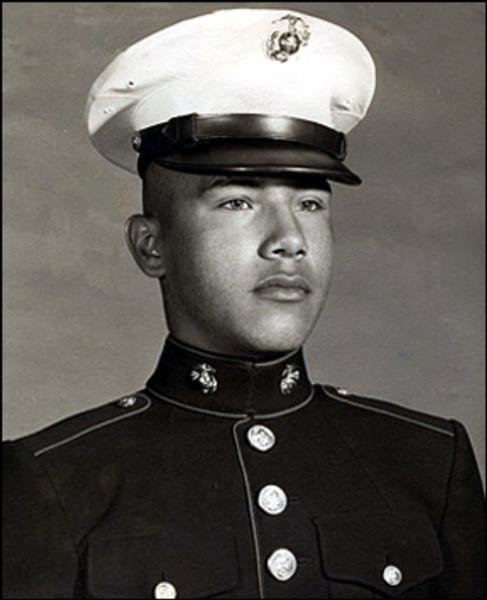
Born June 16, 1951 in Ohsweken, Ontario to Edwin Fraser and Gwendolyn Smith, Thomas Fraser was a proud member of Six Nations of the Grand River. Raised in Detroit, he dropped out of high school and enlisted on June 18, 1968. He arrived in Vietnam on July 27, 1969, after turning 18, and was assigned to Headquarter and Headquarters Squadron (H&HS) 1 Marine Wing Headquarters Group 1 (MWGH-1) 1st Marine Air Wing (MAW) at the Da Nang Air Base in Quang Nam province as part of their Military Police security detail. On the evening of April 3, 1970, he and a corporal were preparing for their Evening Colour duties, or flag-lowering ceremony. A sergeant entered the Command Post (CP) and placed his semi-automatic pistol on the desk. The corporal picked up the pistol, removed its magazine, pointed the weapon to the right and squeezed the trigger. Tragically, he had not pulled back the slide to ensure that the weapon was properly clear, and there was one round still in the chamber. The pistol discharged and Fraser received a critical head wound. Though he received medical attention quickly, the wound was fatal: he died at approximately 1:55 am. Both the sergeant and the corporal were blamed for the careless handling of the firearm that resulted in Thomas’ death. His body was escorted back to Six Nations by a detachment of US Marines. He was buried with full military honours, including a 3-round rifle volley, in St Barnabas Cemetery on the Six Nations Reserve. He was survived by his parents, and siblings James, Joanne, Delores and Frances.
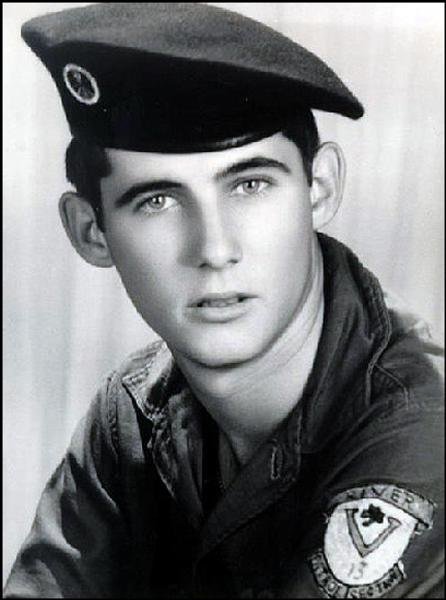
Gilbert (Gil) Graham was born in London, Ontario, on 24 Feb 1946 to James A and Phyllis Graham. Having immigrated to California with his family, he graduated from Magnolia High School in Anaheim, CA as part of the class of 1964. Two years later, on May 28, 1966, he married Carol D Orrell. After joining the Navy, Gil completed his training before being sent to Vietnam as part of the growing US ‘Brown-water Navy’. This force focused on the inland waterways and coastline. One of the dominant geographical features of South Vietnam is the Mekong River and its delta. The Brown-water Navy used Patrol Boat, Rivers (PBR) which were fast, equipped with fibreglass hulls, comparatively heavily-armed and used a water-jet propulsion system. They were tasked with stopping the North Vietnamese from using the rivers and coastlines for resupply missions. Gil was assigned to PBR-100 as a twin .50 Calibre forward gunner, part of River Squadron 51, Task Force 116, United States Naval Forces Vietnam (USNAVFORV). On September 28, 1967 during a routine patrol 8 kilometres northeast of Vinh Long, PBR-100 came under attack. While inspecting sampan traffic near the mouth of Cai Coi Canal, the PBR was ambushed by a volley of B-40 rockets and small-arms fire. Three rocket rounds struck the boat and killed both Gilbert and the boat captain, Engineman Petty Officer Second Class Musetti. The rest of the crew and an accompanying Vietnamese police officer were blown into the water, and the boat caught on fire and went out of control. An accompanying PBR was able to locate and rescue the survivors in the water. There were extensive searches made for both missing men, but neither of the bodies were recovered. Gil was survived by his widow, parents and siblings Rick, Steve and Wendy.
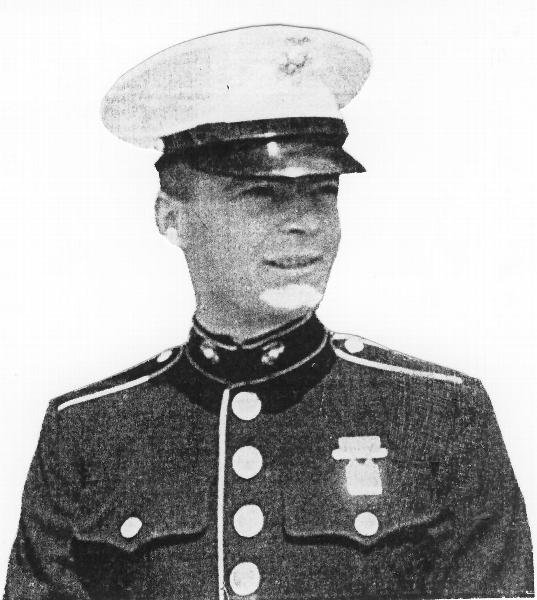
Born on January 8, 1949 in Espanola, Ontario to Thomas and Winnifred Kennedy, Bruce Kennedy grew up spending his summer vacations working at the local mills. After graduating from Espanola High School, he was intent on doing more than just staying in his small town and decided to fight in Vietnam. To pursue this goal, Kennedy enlisted in the US Marine Corp (USMC) on December 17, 1967. After completing basic training, Bruce was deployed to Vietnam on May 24, 1968 as part of Company L, 3rd Battalion, 3rd Marines, 3rd MARDIV (Rein) FMF. Barely three months into his active deployment, he took part in Operation Lancaster II. After failed efforts to locate the PNVA, the L Company set up a defensive position in Cam Lo District of northern Quang Tri Province. As was standard procedure, a Listening Post (LP) was created outside the perimeter to detect any enemy activity and to act as early warning to the rest of the unit. Kennedy was one of the three marines sent out to man this position. Shortly after arriving at their post, the area came under heavy PNVA mortar attack, followed by an infantry assault. Though Kennedy and the marines ardently defended the LP, it was quickly overrun by the numerically superior force. Retreating to the unit’s main position, Bruce was wounded and eventually killed by gunfire. As a result of his actions, he was posthumously granted the USA’s third-highest award for gallantry in the field, the Silver Star.
He was buried in Espanola and was survived by his parents and two sisters.
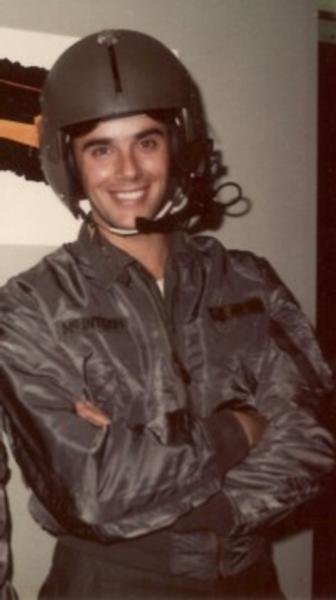
Born on September 21, 1948 in Scotland, Ian McIntosh moved to Peterborough, Ontario, Canada, with his family. His enlistment papers note St. Catharines, Ontario as his home address. “Scotty”, as he was known, had worked for ICI Grangemouth in their laboratory. In 1970, he was sent by the Army to the Advanced Rotary Wing Flight Training Course at Fort Wolters, Texas, to qualify as a pilot. He was assigned as Utility/Observation Helicopter Pilot to A Troop, 2nd Squadron, 17th Cavalry Regiment, 101st Airborne (Air Mobile). On November 24, 1970 he was aboard a OH6A “Loach” as an observer. The helicopter, tail number 6717384, was being flown by Captain Robert J. Young. The Loach was part of an armed reconnaissance patrol accompanying two AH-1 “Cobra” gunships south of Keh Sanh in Quang Tri Province. They had been airborne for 63 minutes, when they found what they believed to be a PNVA encampment. The Cobras moved in and attacked the location with a combination of rockets and machine gun fire. Young then flew his helicopter into the area to observe the effectiveness of the strike. The Loach was fired upon from the ground and was struck in the left front where McIntosh was seated. On taking fire, Young reefed the OH6A around and immediately exited the area. He then noticed that McIntosh was hit and in considerable pain. It became apparent that the engine of the Loach had taken damage and was failing. The engine quit and Young was forced to crash-land. Young managed to escape the wreckage, but the helicopter exploded with McIntosh still aboard. The pilot believed that Scotty had died before the explosion. As no body was recovered, Scotty is listed as Missing in Action or MIA.
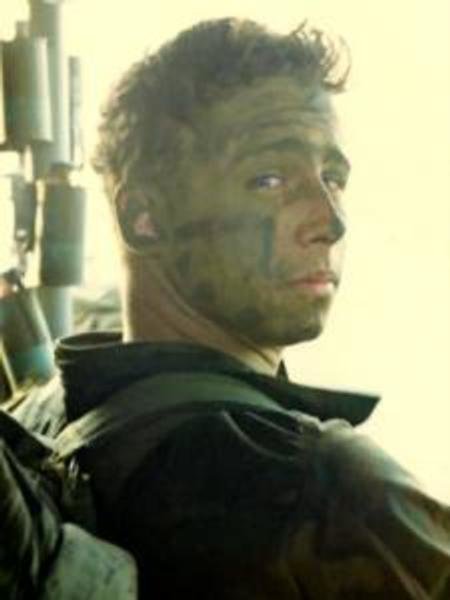
Robert McSorley was born on March 26, 1951. By 1968 he had grown tired of the quiet life at Templeton Secondary School in East Vancouver. At 17 and wanting adventure, Robert made the decision to join the US Army. Though his parents, Peter McSorley and June McSorley (née Wilson), had tried to dissuade him, they eventually relented and signed his permission to enlist forms. After his basic training and advance training as a Ranger, Robert was assigned to 75th Infantry, L Company, 101st Airborne (Airmobile) Division stationed in Quang Tri Province, Republic of Vietnam. In early April 1970, his 12-man Ranger unit was sent as part of Operation Grasshopper into the A Shau Valley. Here they were to infiltrate into the area along the famous Ho Chi Minh Trail. The primary function of the unit was to gather intelligence about Viet Cong troop movements and to direct airstrikes. The men were brought into the thick jungle by helicopter. The aircraft attracted the attention of the PNVA soldiers in the area, who quickly moved to attack the Rangers’ position. Using their M-16s the US unit was able to drive off the initial assault, leaving a number of wounded and dead attackers. On April 8, 1970, Specialist 4 McSorley was killed while ‘walking point’ as the Rangers made their way to their original Landing Zone to be extracted. He and an equally surprised North Vietnamese soldier stumbled into each other in the thick foliage. Both tried to fire their weapons, but McSorley’s gun jammed, and he was shot three times in the chest and shoulder. Mortally wounded, he died within 15 minutes, just 14 days past his 19th birthday. He was well regarded by his commanding officer and the men he served with. His remains were returned to Canada, and he was buried in Forest Lawn Memorial Park near Vancouver. He was survived by his parents and sister.
These are a small fraction of the stories of Canadians in Vietnam. There are thousands of personal narratives and tales that we have no record of. What we can say for certain is that these Canadians who served were marked by their experiences, and we owe them a voice in our collective histories.
Written by Kris Tozer for Honouring Bravery
Sources
Boyko, John. “Canadians Fighting in Vietnam.” John Boyko: Aurhtor and Selwyn Township’s Lakefield Ward Councillor, John Boyko, 5 April 2021, https://johnboyko.com/2021/04/05/canadians-fighting-in-vietnam/. Accessed 6 February 2026.
Canadian Vietnam Veterans Memorial Association. “The Canadian Vietnam Veterans Memorial Association.” 1995, https://www.canadiansinvietnam.com/. Accessed 4 February 2026.
Corday, Chris. “50 Years since the US ground war began, there’s a push to remember the 134 Canadians killed.” CBC, 11 November 2015, https://cherrieswriter.com/2015/11/13/lost-to-history-the-canadians-who-fought-in-vietnam. Accessed 4 February 2026.
Drohan, Patricia. “Foucaults travel to Vietnam in memory of Espanola soldier.” The Mid-North Monitor, The Mid-North Monitor, 28 March 2019, https://www.midnorthmonitor.com/news/local-news/foucaults-travel-to-vietnam-in-memory-of-espanola-soldier. Accessed 5 February 2026.
Harding, Jim. “A Marine by Choice, He Dies In Vietnam from Buddy’s Bullet.” Brantford Expositor [Brantford], 18 April 1970, https://www.fold3.com/image/713061144/the-brantford-expositor-sat-apr-18-1970-c. Accessed 10 February 2026.
P.O.W. Network. “Graham, Gilbert James.” You are not forgotten, POW Network, https://www.pownetwork.org/bios/g/g380.htm. Accessed 9 February 2026.
P.O.W. Network. “You Are Not Forgotten.” McIntosh, Ian, P.O.W. Network, https://www.pownetwork.org/bios/m/m395.htm. Accessed 9 February 2026.
Vietnam Veterans Memorial Fund. “The Wall of Faces.” Thomas Edwin Fraser, Vietnam Veterans Memorial Fund, 8 October 2020, https://www.vvmf.org/Wall-of-Faces/17074/THOMAS-E-FRASER/. Accessed 10 February 2026.
War Times. “Remembering and Researching Canada’s Military Contributions.” Persons From Canada who died in the Vietnam War, 22 November 2018, https://wartimes.ca/forums/viewtopic.php?t=644. Accessed 4 February 2026.
Vietnam Agent Orange Relief & Responsibility Campaign. “Cost of the Vietnam War”