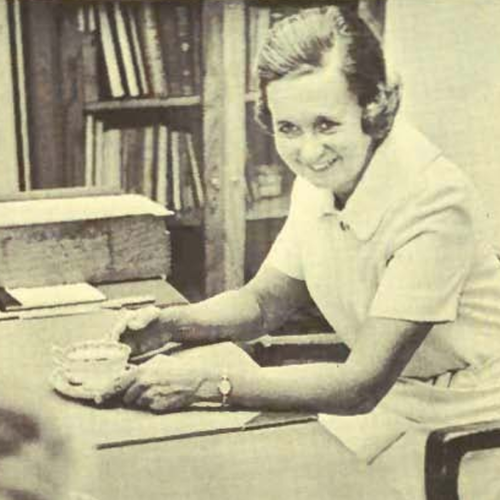
Mary Joan Fitzerald was born on June 21, 1920, in Halifax, Nova Scotia. Fitzgerald attended the Convent of the Sacred Heart before training as a nurse at the Halifax Infirmary School of Nursing. She graduated from nursing school in 1941 at the heart of the Second Word War and decided that she wanted to use her new skills to benefit the war effort. She thus enlisted in the Royal Canadian Army Medical Corps and became a Nursing Sister in 1942. Sadly, that same year Fitzgerald’s brother Jack, who was serving as an air gunner in the war, was killed when his plane was shot down over the Netherlands.
Fitzgerald was posted in St. John’s and Botwood, Newfoundland for six months each before travelling to England to join the No. 18 General Hospital. During the Italian campaign, she was sent as a reinforcement Nursing Sister for the No. 5 General Hospital in Italy. When the 1st Canadian Division left Italy, the military relocated the hospital to Belgium. Fitzgerald moved with the hospital and worked there until she was demobilized in November 1945. However, her service in the war was only the beginning of a long military career that spanned over 30 years.
“When you’re young, you never think of doing something all your life. You find you’ve made a career of it when you’re almost Finished”
—M. Joan Fitzgerald (quoted in McKinsey, 1972).
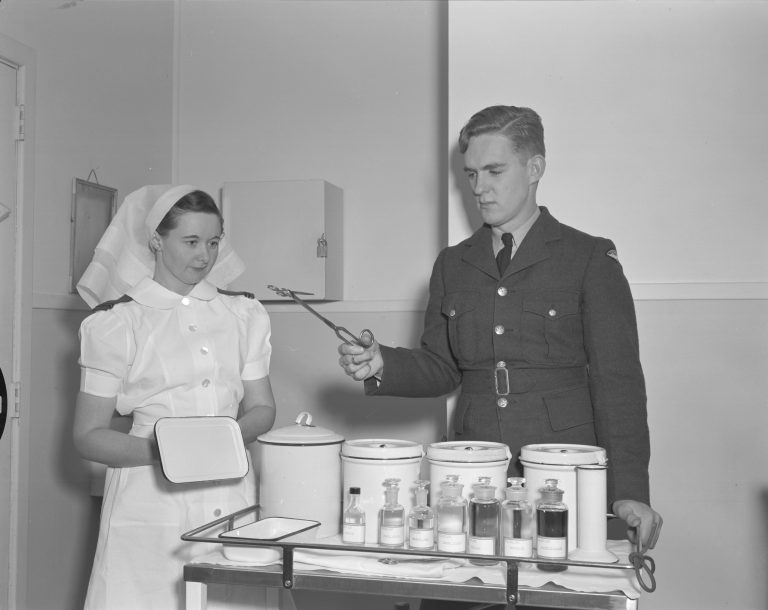
Due to her service, Fitzgerald was entitled to have education support through the War Service Grants Act. She used this support to attend the University of Ottawa, where she studied public health. By the time she graduated in 1948, the Royal Canadian Air Force needed nurses to help train medical assistants in public health. Fitzgerald jumped at the chance. She worked at CFB Rockcliffe in Ottawa. While there, she was briefly the social editor for the base’s newspaper The Rocket. In October 1949, Canada officially began issuing campaign medals for the Second World War. Fitzgerald was selected to be one of the few service members to have their medals personally presented by Defense Minister Brook Claxton.
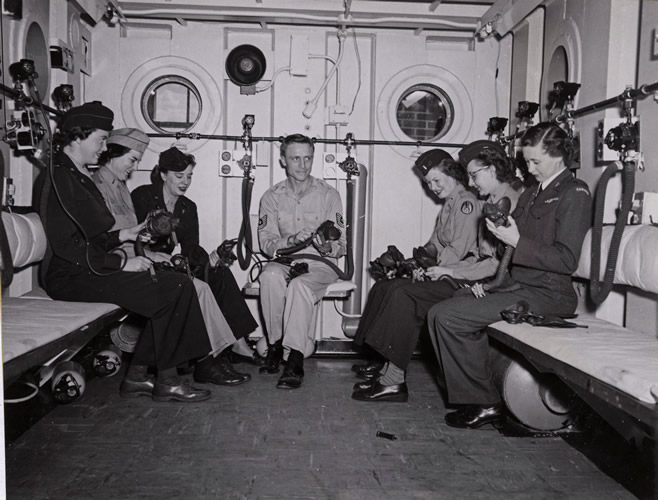
In 1950, after the start of the Korean War, Fitzgerald enrolled in a flight nurse course at the Alabama Branch of the School of Aviation Medicine at Gunter Air Force Base. She was the only Canadian of the 50 nurses enrolled. The six-week course covered many topics including patient evacuation techniques, aeronautical science, rescue and survival skills, and neuropsychiatry. Fitzgerald and the other students practiced their skills in simulations and during real flights. By the end of the course, Fitzgerald was ready to perform flight nurse duties overseas. In November 1950, Fitzgerald became the first RCAF flight nurse to serve in the Korean War. The RCAF flight nursing program ran from 1950-1955. In total, 40 Canadian flight nurses, who usually worked in pairs, participated in the program and completed hundreds of medical evacuations in the Pacific and Canada. They did not serve directly in Korea. Instead, they were based in Hawaii and attached to the US Air Force.
Fitzgerald flew from Japan, where she and her team picked up wounded soldiers, and treated the soldiers during their evacuation to Hawaii and California. Providing care during flights was challenging. Some planes had the capacity to transport 69 injured military personnel, all of whom needed care. Anyone who was injured had to be transported in special stretchers (called litters) and there was little room for the nurses to sit. The cabins of the airplanes were also not pressurized, which meant that nurses would have to consistently provide oxygen to patients if they needed to fly higher than 10,000 feet. Suffice it to say, Fitzgerald would have been very busy on these flights.
Fitzgerald returned to Canada in 1951. By December, she ran the medical assistant training program at RCAF Station Aylmer in Ontario. Her recommendations and experiences from Korea also led to more Canadian nurses and medical assistants being trained in flight care. In 1953, she was chosen as one of 14 women in the RCAF to participate in the Coronation parade for Queen Elizabeth II. Before leaving for England, the Air Vice Marshall Frank Walt presented her with the United Nations Service Medal for her work in Korea.
In 1954, Fitzgerald took an educational leave from the RCAF to complete a certificate in nursing administration at the University of Toronto. Upon her return, she worked her way up from staff officer, to regional matron for Air Defence Command, and then to Director of Nursing at the Canadian Forces Hospital in Kingston. Finally, in January 1968, she became the Director of the Canadian Forces Medical Service in Ottawa. As the Director, she managed hundreds of nurses and medical assistants in 58 nursing stations, including CFB Lahr in Germany. She advised on public health matters concerning military families and also advocated for better nursing equipment and practices, which helped modernize military nursing.
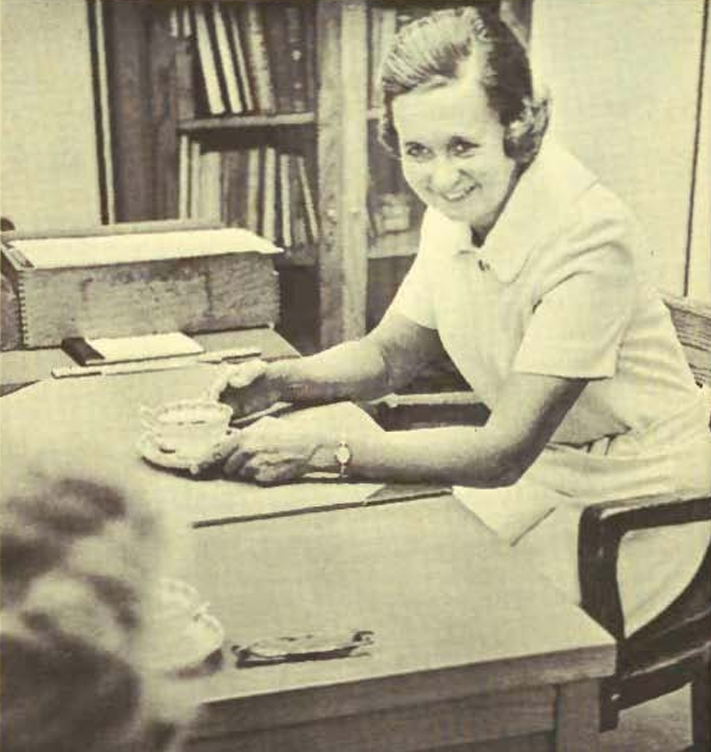
“Mary Joan Fitzgerald assumes her role with dignity, good humour and quiet efficiency.”
—Lockberg, The Canadian Nurse, 1971
On July 1, 1972, Fitzgerald was promoted to Colonel. She was the first woman to become a Colonel during peacetime. That year she also became the first woman to attend the National Defence College. As part of the course, she travelled to multiple countries in 1973, including Singapore. In 1975 Fitzgerald became an Officer of the Order of Military Merrit for her distinguished service. Fitzgerald retired in 1976 after a long military career. She moved back to Halifax and lived there until her death in 2013. She is buried at Gate of Heaven Cemetery in Lower Sackville.
Mary Joan Fitzgerald was a pioneer and true leader. She devoted her life to the care and well-being of others and used her experiences to train countless nurses and medical assistants.
Written by Anthony Badame for Honouring Bravery
Sources:
Byramji, Nancy (1973). “A Double first for touring Colonel Joan” The Straits Times, January 19, 1973, pg 19.
Calgary Albertan (October 6, 1949). Receive Decorations in [sic] behalf of all Service Personnel. Page 1.
Hood, Michael and Jenkins, tom (2023). Pathway to the Stars. Aveo University of Toronto Press.
Lockberg, Liv-Ellen (1971). “The Colonel is a Lady- and a Nurse” The Canadian Nurse Vol 67(11).
McKinsey (1972). No Bias in Forces. Ottawa Citizen, August 4, page 28.
Montgomery Advertiser (November 12, 1950). 50 flight nurses learn fundamentals of air evacuation here. page 13.
Ottawa Citizen (March 10, 1949). RCAF Rockcliffe page 28.
Ottawa Journal (April 28, 1953). RCAF Coronation Contingent Smart in Final Inspection. Page 21.
Rawling, Bill (2004). The Myriad Challenges of Peace. Government of Canada.
Wright, Harold (1999). Salute to the Air Force Medical Branch on the 75th anniversary Royal Canadian Air Force.