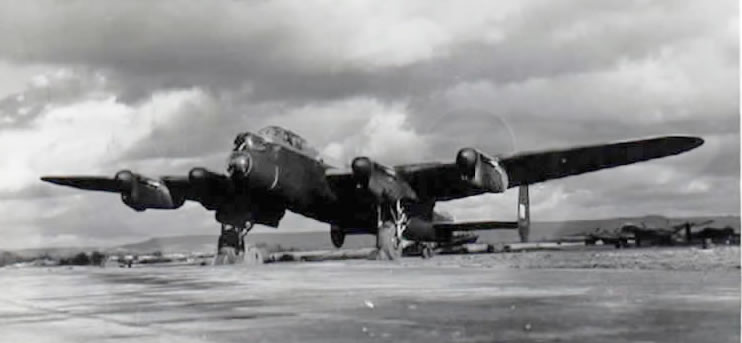
On February 4th, 1945, engine 3 of PA219, a Lancaster of the 433 Squadron (Porcupine) began its start up. The right-hand inboard Rolls-Royce V12 Merlin coughed to life, followed in succession by engines 4, 2 and finally 1. With all four propellors spinning, the Avro bomber taxied to the end of the runway at Skipton-on-Swale, Yorkshire, England. It was to take part in a 238-plane mission to bomb Bonn. After a final checklist, Flight Lieutenant (F/L) Neil Mara, DFC, released the brakes on call sign ‘Mike’ and rolled down the runway. At approximately 17:35, the aircraft lumbered into the air for its final flight. This was Mara’s 23rd trip into hostile Europe with his experienced crew. On board was one man on his first operational flight: Second Pilot, Flight Officer (F/O) C. H. Howald.
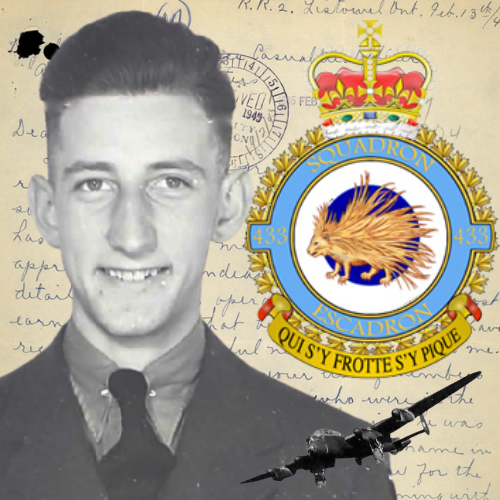
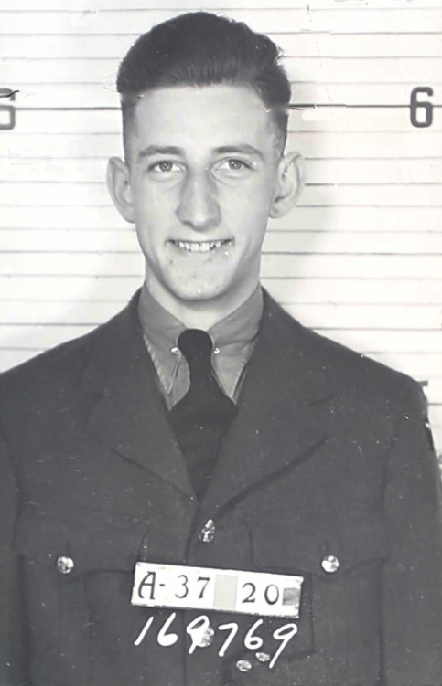
Born near Listowel, Ontario, Carl Herbert Howald was the son of Herbert and Margaret née Vogt and had joined the Royal Canadian Air Force (RCAF) on July 2, 1942. He had completed his Senior Matriculation two years prior and had been working as a Drug Apprentice for E.M. Creighton since graduation. This was considered a promising career path at the time, and it made him an attractive candidate for the RCAF, which had been given priority on high quality applicants. With his background and education, he was immediately recommended for officer training.
Like all new recruits, Carl was put through a battery of tests before beginning his flight training, and he was found to be an above average candidate. His evaluation scores show he was particularly strong in his Ground School work. Like all future bomber pilots, Howald would be taken through a succession of aircraft, starting with the slow and very forgiving Tiger Moth. He then advanced to the famous Harvard before moving onto the dual engine Oxford trainer. It was during this time in training, he met and married Ruth Katherine Waters of Stratford, Ontario on January 1, 1944. By late April of the same year, he was in the United Kingdom.
After advanced training on the Wellington bomber, Howald and his assigned crew arrived at the 433 Squadron Headquarters on December 23, 1944, just as the Porcupines were in the midst of transitioning to the more powerful Lancaster. This would require some retraining for Carl and delayed his deployment to operational status. After years of training, he was ready for his final check. He was required to fly along with an experienced crew to get a better understanding of what was involved in a raid against German targets. He would fly as a supernumerary Second Pilot. This requirement placed him aboard Mara’s PA219.
In daytime, the American 8th Air Force adopted a tactic of tight box formations for mutual protection against German defences. Bomber Command had a different approach for nighttime area bombing. With the inherent risks associated with flying in the dark without lights, the RCAF flew a stream of aircraft. Each individual bomber had its own carefully laid out flight plan, designed to keep the planes apart. Their instructions were to strike their targets in succession and then return to base.
That same February night, KB787, a Lancaster from the RCAF’s 419th Squadron (Moose) piloted by F/L John Barlow, was making its way back to RAF Middleton St. George. Its veteran crew had likewise been involved in the largely unsuccessful strike on Bonn. For reasons that are unclear to this day, these two veteran flight crews failed to see each other and, at approximately 22:00, suffered a midair collision near Courtil, Belgium. Over the next few days, fourteen badly mutilated and burned bodies were located. Only the Wireless Operator/Air Gunner (WOP/AG) of the KB787, F/O C.T. Sutter, survived. Sutter had no memory of what had happened or how he escaped the aircraft. The two planes had landed about a mile apart in an area that had recently been a part of the Battle of the Bulge.
Did you know?
Bomber Command was one of the most dangerous arms of Canada’s war effort, with estimates of as few as 16% of airmen completing their tour without become a casualty.
Four days after PA219 left her base, the Howald family was informed that Carl was missing. That notification came with a list of the men who were on the flight with him. On February 13, 1945, the family sent a letter to the RCAF Casualties Officer. In this letter, the family expressed their sorrow and disbelief. They grasped at hope that some kind of clerical error had been made.
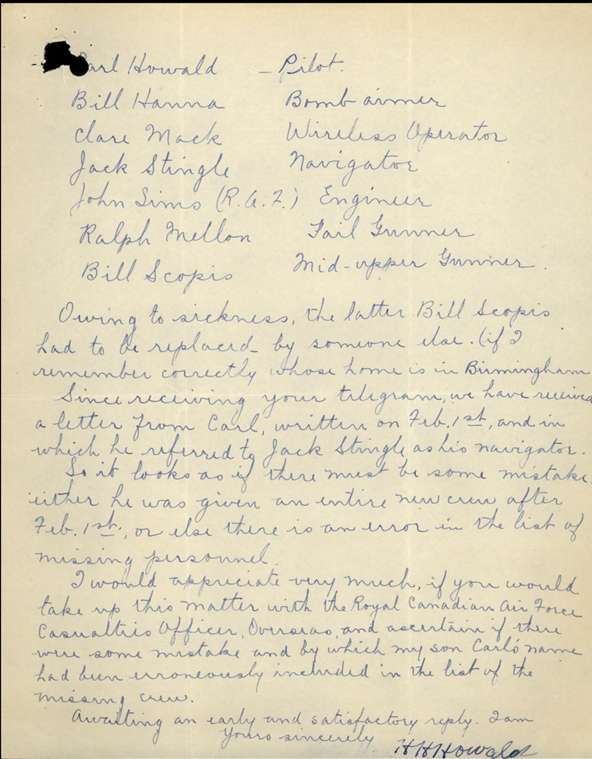
In response, the RCAF initiated a very thorough review. A series of memos and reports were traded between Canada, the UK and Belgium.
On June 23, 1945, his father and mother received formal notification from the RCAF informing them that Carl was now confirmed to have been killed on February 4th and had been buried in a field near the crash site. That letter vanquished all hope for the return of their beloved son. They now were among the 42000 grieving Canadian families. After the war, the Canadian government adopted a policy of reinterring fallen service men in larger, centralized cemeteries. F/O Howald was eventually buried at the Hotton War Cemetery, Plot IV.A.8 in Belgium, along with the rest of the crews from KB787 and PA219.
Of the seven members of Carl’s original Wellington crew, four, including Carl, died during RCAF operations in 1945. By some strange twist of fate, all of them were killed in midair crashes. William Hanna, Jack Stingle and Ralph Mellon were all reported missing on April 25, 1945, as members of the crew of KB831, a Lancaster from the 431 Squadron (Iroquois). Their plane had collided with KB822, another Lancaster from the same squadron.
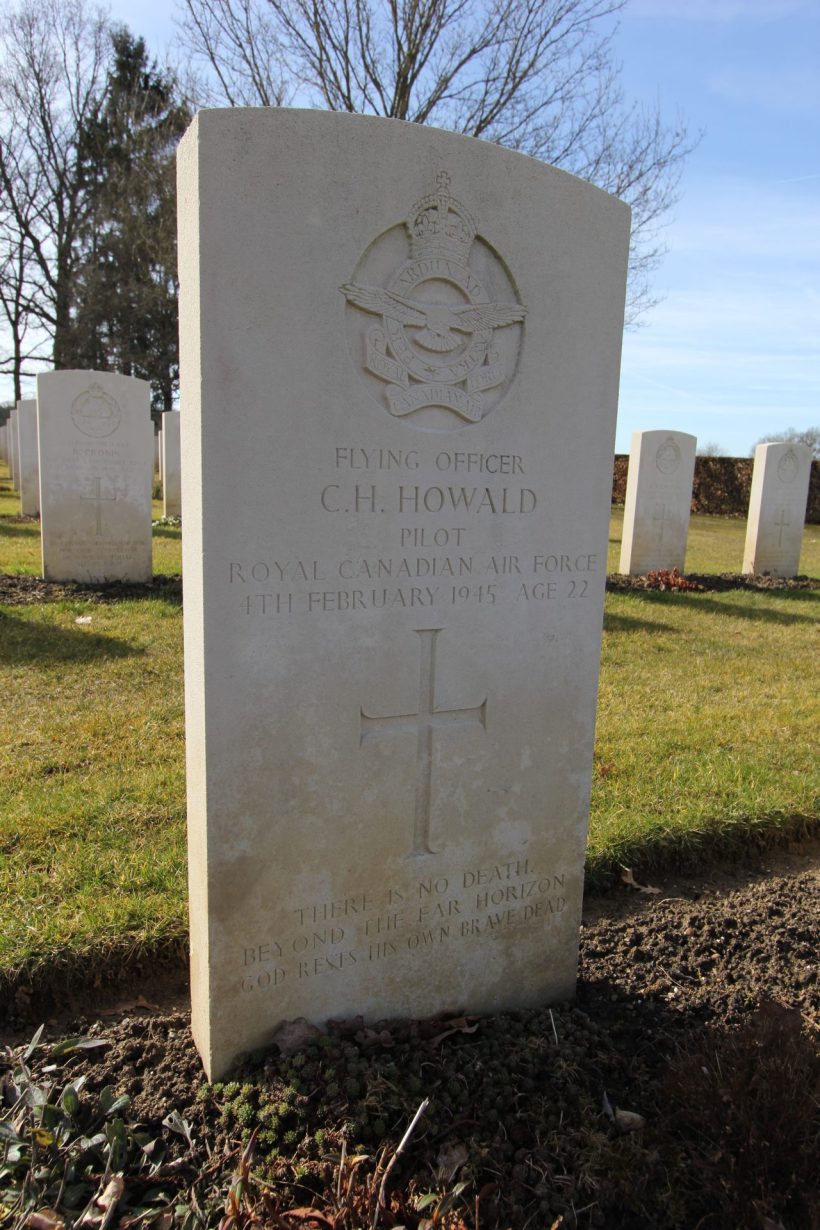
The Howald family would never truly recover from the loss of their bright and talented son. Carl’s parents sent a personal epitaph to be inscribed on his headstone: “There is no death Beyond the far horizon God rests his own brave dead”. His mother, known locally only as ‘Mrs. Howald’ would outlive Herbert by almost three decades, and live to be 96 years old. She was survived by three of her children, 13 grandchildren and 17 great-grandchildren. Carl’s widow, Ruth, married Henry Trant on June 30th, 1945, and raised five children. After finishing his tour of duty, F/O Christian Sutter, the sole crash survivor, returned to Redvers, Saskatchewan, where he lived until his death in 2014. He was awarded the Order of Canada in recognition of his work in Agriculture.
Guest written by Kris Tozer for Honouring Bravery