March 16, 1917, the snow lay in patches on the ground as the soldiers began to form up ranks for the customary battalion photo. All of the men were wearing the uniform of the Canadian Expeditionary Force (CEF) with this unit’s distinctive shield-shaped cap badge. The contingent of musicians with their instruments led by Band Master Sergeant G.W. Steward took up their position at the rear as the other four sections fell in. Amongst the 600 enlisted men on that field were: Sergeant Albert Alberga, a Jamaican civil engineer; Charles Owens, a Pictou farmer; Thomas Reid and brothers William, Joe and Sheldon Parris, all labourers from Nova Scotia; Ontarian Henry Courtney; and British Columbian Robert Whims. Uniquely, men in this unit were drawn from the four corners of the dominion and beyond. As the soldiers settled in, former railway conductor Daniel H. Sutherland, now Lieutenant Colonel, and his officers assumed their positions in front of the formation. The shutter clicked and captured one of the most important moments in Canadian military history. It froze in time the members of the only purposefully-created, fully-segregated military unit in the CEF: No. 2 Construction Battalion (No. 2).

For generations, the contribution of Black Canadians to our Great War efforts had been largely overlooked or forgotten. Senator Calvin W Ruck’s book, The Black Battalion 1916-1920: Canada’s Best Kept Military Secret on No. 2 brought this lost history to light. He reignited interest in how Black Canadians answered the call to serve in the First World War. This pioneering work pulled back the curtain on the role of Black Canadians in Canada’s development as a nation.
The first recorded Black person in what we now call Canada was Mathieu da Costa, who is thought to have served as an interpreter in the early 17th-century expedition of Samuel de Champlain. While we know da Costa’s name, we also know that other men of African descent served on sailing ships during this period, and we know that there was a larger number of free Black people in Europe than was previously understood. This would suggest that, though unrecorded, there were probably other Black people in Canada’s early history. Later, during the settlement of New France, we know that colonists brought enslaved African peoples with them. The first large-scale settlement came at the end of the American Revolution with the arrival of Black Loyalists. When slavery was outlawed in the British Empire in 1843, the Underground Railway brought escaped freedom-seekers north to Canada. By the time of the Great War, Black Canadians were present across the Dominion, with major concentrations of settlement in Nova Scotia and Ontario. The 1911 Canadian Census records 18,291 persons identified as Black, or approximately 0.21 percent of the total population.
In 1914, the Canadian professional military was small, numbering about 3,000 men, and ill-prepared for the outbreak of war. Canada also had a system of volunteer militias. It was popular at that time to belong to a local militia unit, and its organization often reflected civil hierarchies. The pre-war mobilization plans called for the local militia units to bolster Canada’s small and poorly-equipped army. However, Sir Sam Hughes, the Minister of Militia and Defence, harboured a general distrust for professional military men and made the decision to sweep aside the existing plans, and create a new system of numbered battalions. These units were constituted at the new Valcartier training and assembly camp. This decision caused pandemonium and chaos as active militia men arrived eager to join the first contingent. Existing command and control structures were dismantled. Plagued with nepotism and disorder, Hughes’ new units were sent to the United Kingdom in October 1914. A number of Black men were amongst these new units. Acting Bombardier Ruthven I Pegus, Lt. Lancelot J Bertrand and others joined the largest Canadian military deployment and helped form the 1st Canadian Division.
After the first contingent was dispatched, a system was set up where geographically-specific, numbered battalions were raised for overseas service. Within these units, the Commanding Officer (CO) had full discretion as to who they deemed to be ‘fit’ for service. A number of COs decided to summarily deny entry to Black volunteers— a position that was supported by numerous senior officers, who were quoted as believing that this was a ‘white man’s war’. One of the most famous examples of this systematic racism was a purge of 19 Black men from the 104th (New Brunswick) Battalion under the command of Lt. Col. G.W. Fowler. Some COs, on the other hand, accepted Black volunteers and they served with regular line units. For example, Private Ethelbert ‘Curley’ Christian, Driver James Grant MM, Private Jacob Courtney, Private James M Franklin and many others found their way to the frontlines. It is believed that upwards of 800 Black men were able to enlist in various units in the CEF; over a hundred of these men saw active combat.
The rejection of Black men on the grounds of ‘fitness’ led to outrage in the community and demands that Black men be allowed to serve. One of the most notable voices pushing for inclusion in the war effort was the editor of The Canadian Observer, JRB Whitney. This prominent activist’s paper was the self-proclaimed “Official Organ for the Coloured People in Canada” and made repeated calls for full integration of his community into the larger body politic. His eloquent, logical and persuasive letters pointed out the hypocrisy inherent in denying the service of these willing and able men. In parallel, the British military had come to realize the importance of Labour Battalions. These units performed critical support functions for the fighting force, like timber harvesting, road construction and so on. The new British direction provided the Canadian government with an opportunity to solve their growing problem: the creation of a Black Labour Battalion. The No. 2 was thus created in Pictou, NS in September, 1916.
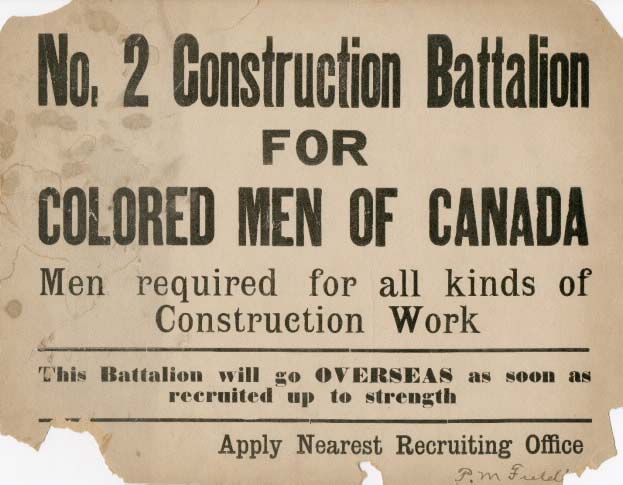
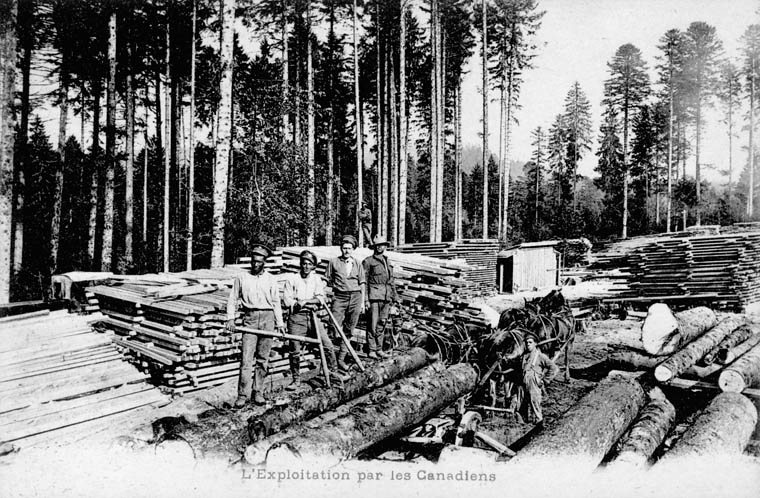
From the beginning, No. 2 was created as a non-combat unit, and it was assigned to the formation most willing to accept them: the Canadian Forestry Corps (CFC). Active recruiting occurred in Nova Scotia, New Brunswick, and eventually in Windsor, Ontario for American enlistees. All told, 767 men volunteered for service. Of these, only 98 were deemed unfit for a variety of medical and disciplinary issues. About 600 men and 19 officers sailed for Europe at the end of March, 1917. Of their number, a full 324 were not born in Canada, and came from places as diverse as the British West Indies, Argentina, and South Africa. Of the 324, 227 were Americans. Upon its arrival in the UK, the unit was redesignated as No. 2 Construction Company, as it was understrength and too small to be considered a Battalion. Lt. Col. Sutherland took a voluntary demotion to Major to stay with his men. The unit spent the war in the forest of the Jura Mountains, harvesting timber. These critical materials were used to construct duckboards, trench walls, railway ties and other critical needs of the war front.
Since their rediscovery, there has been a growing amount of misinformation about No. 2’s service. These myths diminish the contributions of these men. We owe it to them to be truthful and frank about their significant war effort and sacrifices.
Myth 1: The No. 2 was the only unit that Black Canadians could serve in
As stated above, the composition of a unit was at the discretion of its Commanding Officer. There is documented evidence of upwards of 800 Black men enlisting in other units, like infantry, artillery and support services. Other racialized groups also made their way into the military. Some units like the 107th CEF (Timberwolves) were known for the large number of First Nations men enrolled and the 192nd CEF (Crow’s Nest Pass) had a high concentration of Japanese enlistees. Early on, the Canadian Forestry Corps showed its willingness to accept Black soldiers. As a result, a further 200 men served in the No. 7 and No. 8 companies of the Forestry Service.
Myth 2: The No. 2 did frontline engineering projects
The confusion likely stems from misidentified images with Black soldiers from other countries and confusion over the ranks and roles the No. 2 men played in the war. In widely distributed photos attributed to Black Canadian soldiers, men can be seen in dugouts, carrying shovels, working with artillery shells and washing up.
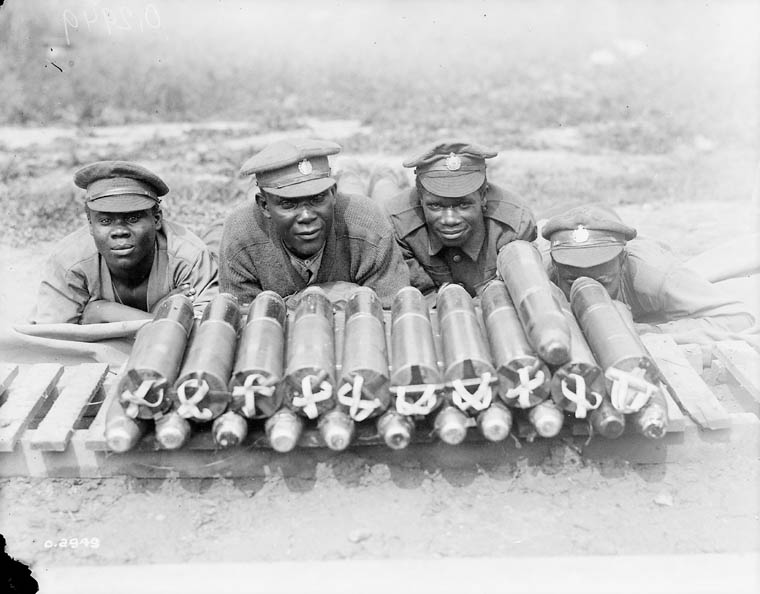
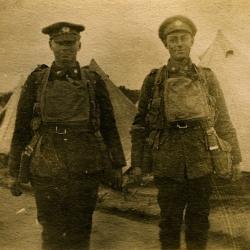
In each of these cases, these are not images of Canadians, but rather images taken by a Canadian photographer. The distinctive cap badge and the Canadian-style uniforms worn by No. 2 should dismiss these misconceptions. The men in the dugout, working with the shells and washing up are clearly wearing the cap badges of the British West Indies Regiment (BWI) and, in the case of the men with shovels, their uniforms identify them as members of the US Army. Other sources imply that because the soldiers held the rank of Sapper, they were involved in frontline engineering projects (for example, building bridges, laying railways or roads, trench digging and demining operations).
Further, in Labour Battalions like No. 2, the rank system that was used was the same as the regular military: Private, Corporal, etc. Within the CFC and Canadian Overseas Railway Construction Corps (CORCC), the ranks were based on the Royal Canadian Engineer system: Sapper, Corporal, etc. After the war, when it was time to distribute the British War Medal and the Victory Medal, there seems to have been some confusion about what organization the company belonged to. The No. 2 was a Labour Battalion, but it was also part of the CFC and therefore the CORCC. This resulted in 23 sets of medals being issued as No 2, 38 sets as CFC and 508 sets as CORCC. This means the majority of the medals to the former members of No. 2 were inscribed with the rank of Sapper. As such, researchers looking at the ranks on these medals presumed the men had acted as engineers and did the jobs associated with that rank.
Myth 3: The No. 2 suffered gassing and enemy shelling
Since the unit served over 200 km from the front, this would have been impossible. The deaths and medical reports recorded for the unit do not support these kinds of casualties. The men who passed away in active service died of disease, injuries or interpersonal violence and not of wounds from enemy actions. The existing research suggests that only two men from the original draft ever served at the front, and they were not part of the contingent who were originally sent to France.
Myth 4: The men of the No. 2 were treated poorly and paid less than other Canadian units
This notion seems to have grown out of the idea of general systemic racism that existed in the CEF at that time and from soldiers’ complaints. Evidence from their personnel files and the files of other similar CFC formations does not support this charge. Any delays in delivery of pay, substandard housing or support was similar to what was experienced by other units serving in southern France. Another aspect of this myth is that they received substandard health care. Their personnel files indicate that they received the same level of care as other units. By and large, their injuries were treated promptly and professionally. An examination of the Diary of Rev White, for example, only mentions one man’s medical condition as having been ignored because he was believed to be malingering.
None of this is to suggest that the men of the No. 2 and Black Canadians in general did not experience racism in their service. There were many indignities and petty slights. High levels of friction existed between the Canadians and the Russian soldiers they worked alongside. An infamous example of indignity was the Iron Rations incident, where over 225 individuals were fined 5 days pay and lost any hope of a Good Conduct Badge. This incident occurred upon their arrival in France on May 2, 1917. The men were transported across the channel without any plans to feed them. When they realized that no food was forthcoming, many men ate their issued rations to stave off hunger. As a result, they were charged with “Making Away with Iron Rations”. Almost two thirds of the men in the unit faced some kind of military justice during their time of service, a much higher rate than was experienced by their comrades in arms.
The factual history of No. 2 deserves our attention. Their willingness to sacrifice for the war effort and their activities in a support role were critical to Canada’s victory. There are a number of war graves in the UK and France that bear silent witness to their labours. We do them and their memory a great disservice by not looking at the truth of their efforts. Historian Kathy Grant believes that over 1400 Black men enlisted in the CEF, making their contribution by population the same as the national average. We need to continue to work on uncovering the history of this unique and historic formation, and through them come to understand our past.
If you wish a deeper dive into this subject, Major M Joost (ret.) has written an excellent article discussing and debunking the myths and examining the contribution of No. 2.
Written by Kris Tozer for Honouring Bravery.
Works Consulted
BC Black History Awareness Society. “No. 2 Construction Battalion: Operational History.” blackbattalionbc.ca, BC Black History Awareness Society, https://blackbattalionbc.ca/operations/. Accessed 27 January 2026.
Black Canadian Veterans Stories. “Bertrand, Lancelot Joseph.” Bertrand, Black Canadian Veterans Stories, 17 February 2025, https://www.blackcanadianveterans.com/post/bertrand-lancelot-joseph-1. Accessed 26 January 2026.
Black Canadian Veterans Stories. “Pegus, Ruthven Ignatius.” Verteran’s Profiles, Black Canadian Veterans Stories, 5 October 2025, https://www.blackcanadianveterans.com/post/pegus-ruthven. Accessed 26 January 2026.
ENGL2130 (F2020) University of Guelph. “WWI and Jim Crow.” The Black Past in Guelph: Remembered and Reclaimed, Untold Stories of Black Life, Culture, and Community in Guelph and Beyond, https://blackpastinguelph.com/wwi-and-jim-crow/. Accessed 27 January 2026.
H.O. Dodge for Sponagle Studio, Truro, NS. “No. 2 Construction Battalion.” Cape Breton Military History Collections, Pictou County Military Museum, 18-7 (1.3), https://www.capebretonmilitaryhistory.com/collections/main-theme-collections/no-2-construction-battalion/no-2-construction-photos-and-postcards-ww1-canada-1916-to-1917/section-1. Accessed 27 January 2026.
Joost, Mathias. “Facts and Myths about No. 2 Construction Battalion.” pp. 1-21.
Joost, Mathias. “No. 2 Construction Battalion: The Operational History.” The Canadian Military Engineers Association, 5 July 2016, https://cmea-agmc.ca/sites/default/files/No%202%20Construction%20Battalion_e.pdf. Accessed 2 February 2026.
Ruck, Calvin Woodrow. The Black Battalion: 1916-1920 : Canada’s Best Kept Military Secret. 2nd ed., Halifax, Nimbus Publishing, 1987.