Canada’s involvement in Afghanistan was unique in a number of ways. It was the first time a NATO member country invoked Article 5, where an attack on one member is seen as an attack on all. It was also one of the largest deployments of the Canadian Armed Forces (CAF) since the Second World War. Furthermore, the war was distinct in terms of the cost of human life.
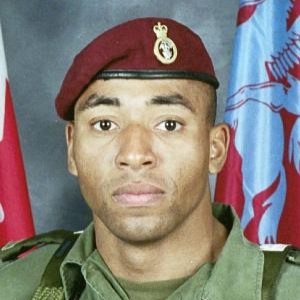
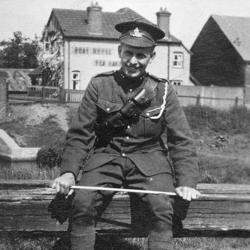
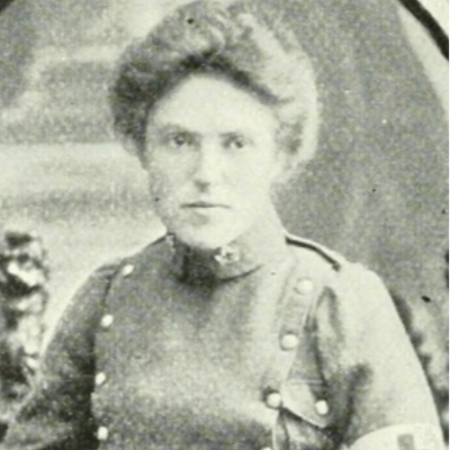
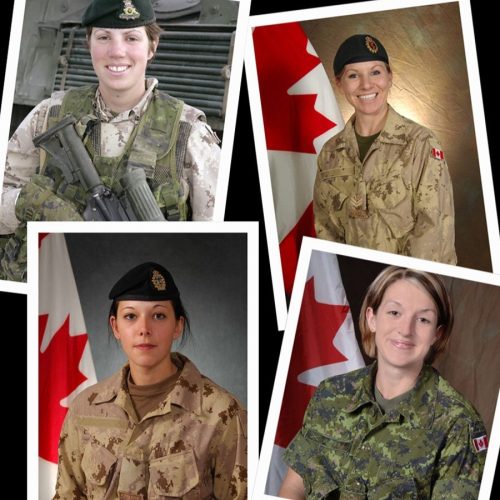
In 2017, Veterans Affairs Canada produced a poster as part of its Canada Remembers series. That poster was of four of the 158 CAF members who had lost their lives during Canada’s operations in Afghanistan. What makes these four faces different was they were all women: Captain N Goddard, Master Corporal K Giesebrecht, Corporal K Blais and Major M Mendes. They both represent Canada’s commitment to international order and reflect Canada’s evolving norms.
The evolution of the role of women in the Canadian military has been slow and convoluted. During the First World War, women were restricted to being nurses in the Canadian Expeditionary Force (CEF). Over 2500 of them volunteered to staff military hospitals in Europe. This was not some distant, safe duty. On May 19, 1918, Nursing Sister Katherine M.M. MacDonald was killed at No. 1 Canadian General Hospital as a result of a German bombing raid. She became the first Canadian female military member killed by direct enemy action. In total, approximately fifty-eight Nursing Sisters died in the First World War.
In the Second World War, partially motivated by efforts to avoid another Conscription Crisis, WLM King’s government created special women’s service units. Their involvement was confined to non-combat functions, thereby releasing voluntarily enlisted males for combat service. As a result, in addition to the approximately 4500 women who served in a medical capacity, a further 45,445 women entered the uniformed services. They enlisted in the Canadian Women’s Army Corps (CWAC), the Royal Canadian Air Force Women’s Division (RCAF WD) and the Women’s Royal Canadian Naval Service (WRCNS). These women took on about 26 different support roles, including as mechanics, drivers, wireless operators, stenographers, and clerks. That is not to suggest there were no dangers experienced by women in the Canadian Military during WW2. Two nurses, Kathleen G Christie and Anna May Waters, were notably captured during the Battle of Hong Kong and experienced the full horrors of Japanese Prisoner of War camps. By the end of the war, approximately 113 Canadian women in uniform had died as a result of accident or illness. In 1946, these units were all disbanded as part of Canada’s demobilization and force drawdown.
During the early 1950s, women were allowed back into the military in segregated units to serve during the Korean War. With the 1968 creation of the amalgamated CAF, these women were rolled into the regular Canadian military. This did not mean that all roles were open to them. They were strictly prohibited from entering the combat arms. It would take a legal case and changing ideas about the role of women before things would change. In 1989, Heather Erxleben became the first woman to serve in the Infantry. During the Gulf War, Canadian women were deployed in active combat roles but did not suffer casualties. The final barrier to full integration fell in 2001 when women were finally able to serve on Submarines. This did not mean that there were no issues of discrimination and harassment to overcome—that struggle continues. However, this evolution of women’s involvement in the CAF became fully apparent in Afghanistan.
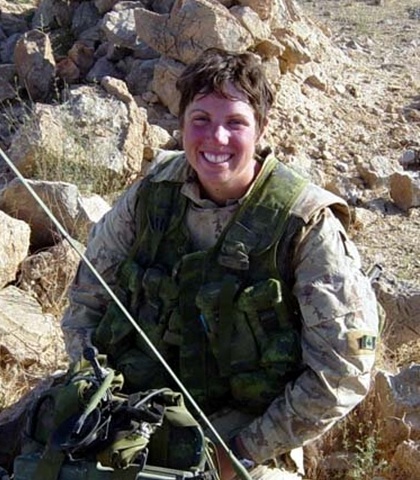
The face on the top left of the poster stands out from the others, as it should. This image of Goddard shows her with her service issue Colt C7A2 automatic rifle equipped with an Elcan C79 optical sight. She is dressed like any member of the Canadian combat arms. Born in Papua New Guinea to Canadian teachers working overseas, she spent much of her youth in Northern Canada amongst the Dene people. In 2001, she graduated from the Royal Military College in Kingston as an Artillery Officer and was assigned to the storied 1st Royal Canadian Horse Artillery (1RCHA). Through hard work, determination and skill, she rose to the rank of Captain. By the time she was sent to Afghanistan, she was a well-respected and professional leader within that organization. Arriving in theatre in January 2006, she was assigned as Forward Observation Officer (FOO) with another famous regular forces unit, the Princess Patrica’s Canadian Light Infantry (PPCLI). On May 17, 2006, she was involved in a combat operation in Bayanzi. Here Goddard distinguished herself through her calm and efficient execution while directing artillery fire on the insurgents. Standing in the open hatch of her LAV III as it maneuvered through the village, the vehicle was struck by a rocket propelled grenade and she was killed. She was the first female Canadian officer to lead soldiers in combat, and sadly the first Canadian female soldier killed in action. She was survived by her parents, Tim and Sally and her husband James Beam. He became the first male recipient of the Memorial Cross. There is a longer article on our website for a more in-depth consideration of her.
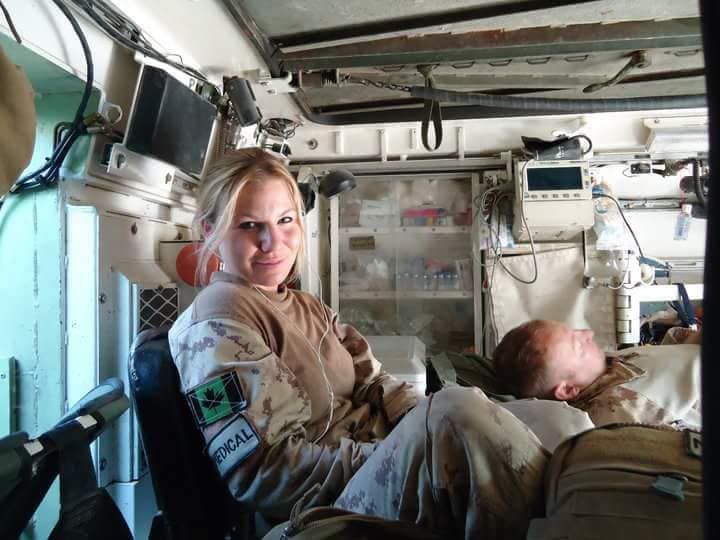
On the top right is the smiling face of MCpl Giesebrecht. Born October 2, 1975, Giesebrecht was a Medical Technician or medic with 1 Canadian Field Hospital (1CFH). From Wallaceburg, Ontario, MCpl Giesebrecht was one of nine medical personnel killed in the War in Afghanistan. Trained as a lab technician, she wanted to do more after the September 11 attacks and joined the CAF on January 10, 2002. Giesebrecht was described as well-respected, professional, and spirited with a winning smile. She was a member of the Kenhteke Kanyen’kehá:ka (Mohawks of the Bay of Quinte), and held a strong belief that chocolate could solve most problems. She served her first rotation in Afghanistan in 2006, and returned for her second tour in 2010. On June 26, 2010, she and Pte. Andrew Miller and were both killed when their LAV III was destroyed by an Improvised Explosive Device (IED) while responding to a report of a mine near Kandahar in the Panjwayi District. IEDs accounted for many of the deaths in theatre. She was survived by her husband, Matthew, and her stepson.
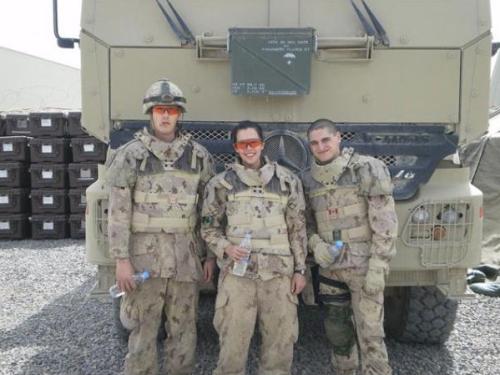
On the bottom left is the face of a serious young woman just starting her career and life. Blais was born in Cowansville, Quebec, south-east of Montreal, and grew up in Les Mechins on the Gaspé peninsula. Seeing more for herself than life working in a convenience store in a small town, she joined the 12e Regiment Blindé Du Canada, 12th Canadian Armoured Regiment (12e RBC), a reconnaissance unit equipped with Coyote light armoured vehicles, in 2006. Her ultimate goal was to become a mechanic and later open her own shop. She knew that there were people in need and saw the military as an adventure and a vocation. She arrived in Afghanistan in late March 2009 for her first rotation. On April 13, 2009, she was involved in a ‘presence patrol’ in Shah Wali Kot District, north of Kandahar. There were no indications that there would be trouble that day, but the Coyote she was in struck an IED. She was the second female Canadian soldier killed in combat. Her mother remembered her as “pretty, funny and full of life” and wrote her this epitaph:
Rest in Peace my little “Nine”,
Each day which passes brings us closer.
I love you,
Mom
Her mother became the 2021 Silver Cross mother. Blais was survived by her boyfriend Hugo, brother Billy, father Gino Blais, mother Josée Simard and grandmother Laurette.
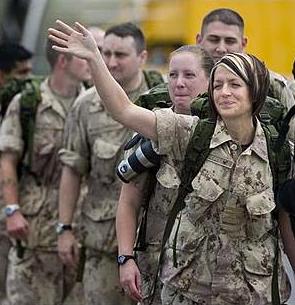
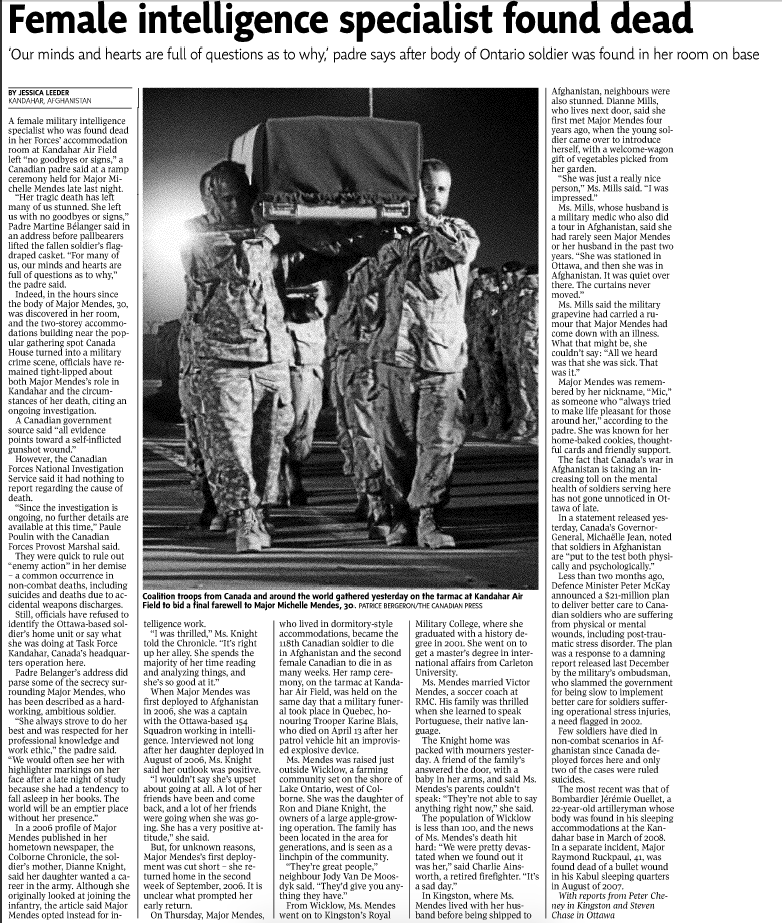
Major Mendes was known as a charger inside the CAF. Her story is one of hard work, and lofty ambition. She was always pushing herself to her limit and beyond. She was raised on the family apple farm, just outside of Wicklow, Ontario. Graduating from RMC in 2001, she pursued her studies with a Master’s Degree from Carleton University in Conflict Analysis and Resolution. She demonstrated a knack for analysis. ‘Mic’, as she was known, had first hoped to be in the infantry, but her aptitudes led her to intelligence work. She was known for her caring attitude and often gave others cards, gifts and home-baked goods. Her first deployment in 2006 was cut short when she was injured, and she was eager to redeploy. She was promoted and was appointed as Chief of Defence Intelligence Kandahar Intelligence Fusion Centre as part of ROTO 7. She struggled with the stress of her high-pressure job and pushed herself to redouble her efforts. The analyses she was to provide could mean life or death for the Canadian soldiers deployed. On April 23, 2009, Mendes was found dead in her accommodations at Kandahar Air Field (KAF). Mic had succumbed to one of the dangers of service that we do not often speak of: mental health, also known as an ‘operational stress injury’ in CAF. She was the third active service member in Afghanistan to commit suicide and the first woman to do so. The War in Afghanistan has continued to take its toll. The estimated number of suicides amongst returned Afghanistan veterans is as high as 160, roughly the same number as those who died in active combat during the war. Major Mendes was survived by her parents, Ron and Dianne Knight, her sister Melissa and her husband Victor.
In many ways, these four faces represent Canada’s willingness to offer its best to the world. Each of their stories is unique. What unites them is their place in Canadian military history as participants in a war where women were allowed to assume the full risk of deployment. We should strive to remember their sacrifice for what they believed to be a worthy cause.
Written by Kris Tozer for Honouring Bravery.
Cover image: poster of Captain N Goddard, Master Corporal K Griesebrecht, Corporal K Blais and Major M Mendes (Veterans Affairs Canada).
Sources:
Berthiaume, Lee. “Spike in Afghanistan-related suicides may be receding: Military.” CBC, 16 April 2019, https://www.cbc.ca/news/politics/forces-afghanistan-suicides-receding-military-1.5100119. Accessed 13 January 2026.
Blatchford, Christie, and Jessica Leeder. “A Soldier’s Story: ‘Did we push her too much?’” Globe and Mail, 20 June 2009, https://www.theglobeandmail.com/news/national/did-we-push-her-too-much/article4277429/?page=all. Accessed 13 01 2026.
Dixon, Anthony. “A touching tribute.” Pembroke Daily Observer, 7 July 2010, https://www.pembrokeobserver.com/news/local-news/pain-of-losing-master-cpl-kristal-giesebrecht-in-afghanistan-still-fresh-for-her-family. Accessed 9 January 2026.
Government of Canada: Veterans Affairs. “Female intelligence specialist found dead.” Major Michelle Linda Mendes, https://www.veterans.gc.ca/sites/default/files/styles/crop_freeform/public/image/casualty/80003528_7.png?itok=5KD8l4up. Accessed 11 January 2026.
Government of Canada: Veterans Affairs. “In memory of: Corporal Karine Marie Nathasha Blais.” https://www.veterans.gc.ca/en/remembrance/memorials/canadian-virtual-war-memorial/684687. Accessed 11 January 2026.