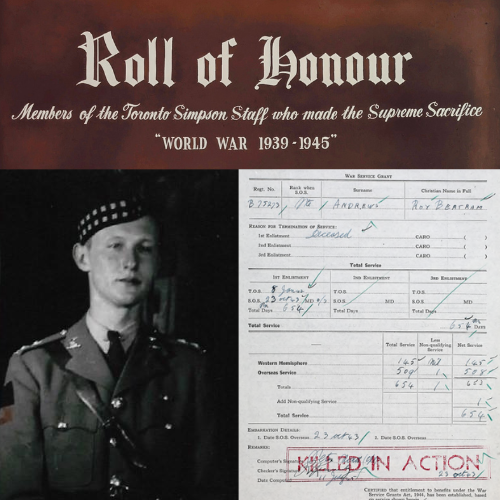
Upon the outbreak of the Second World War, Canadians from all walks of life left their jobs to volunteer for military service. After the war, the schools, workplaces and organizations to which these volunteers belonged erected memorials to remember their service and sacrifice. One such monument was a Roll of Honour put up in the Simpsons department store in downtown Toronto. An incredible 52 Simpsons employees gave their life during the Second World War.
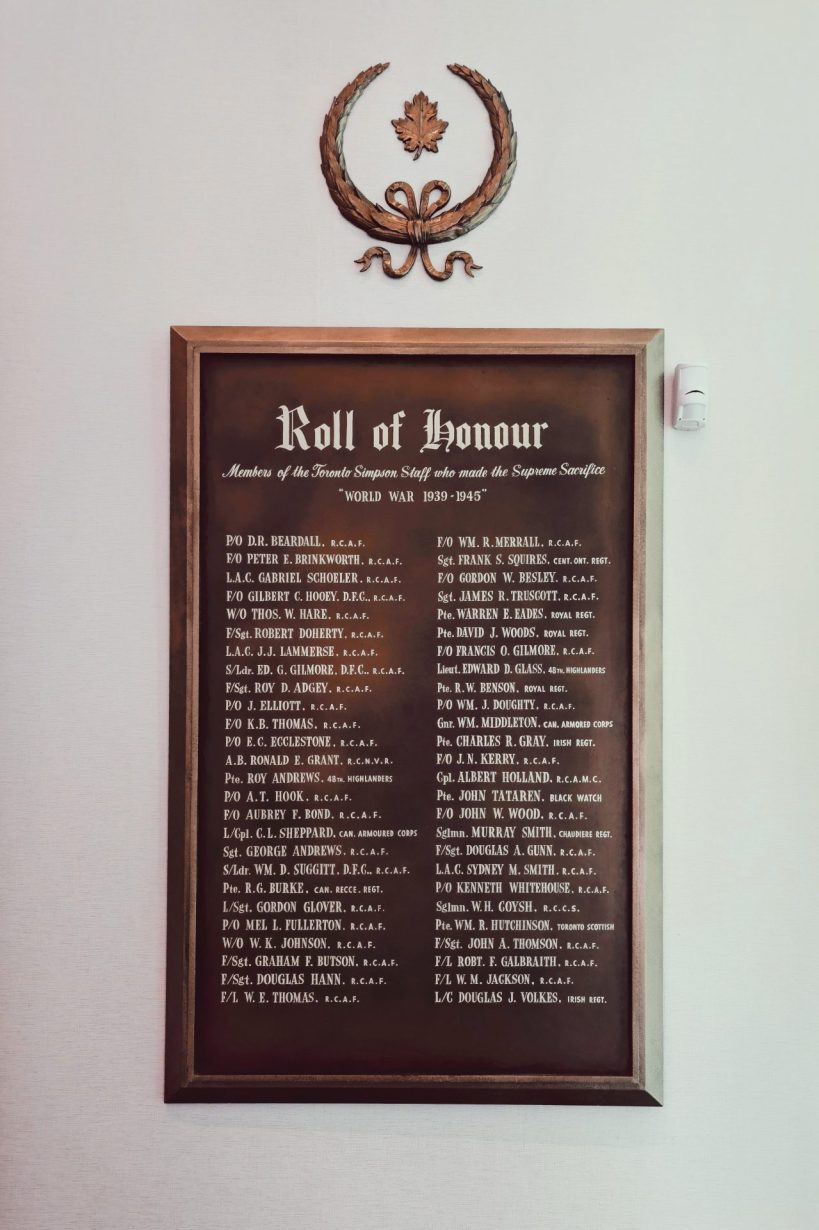
When Simpsons was acquired by the Hudson’s Bay Company in 1991, the Roll of Honour remained on display in the basement of Simpsons Tower. When the last of the Hudson’s Bay Company stores closed in 2025, the Roll of Honour found itself without a home. Thanks to the hard work of people like Patrick Shea, a lawyer and member of the 48th Highlanders’ Senate, it has since been moved to the TD Bank branch on Toronto’s front street, located at the same site as a former Simpsons warehouse.
Two of the names from the Simpsons Roll of Honour were members of the 48th Highlanders of Canada: Lieutenant Edward Drew Glass and Highlander Roy Andrews.
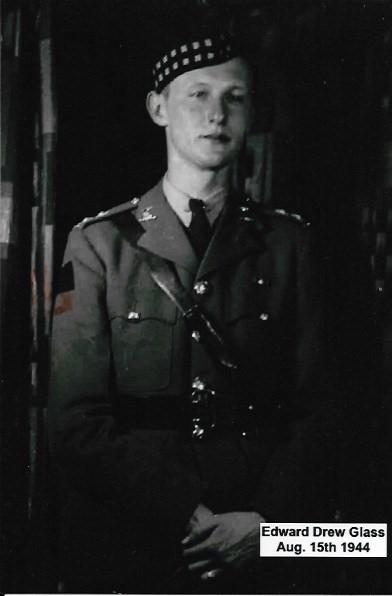
Lieutenant Edward Drew Glass
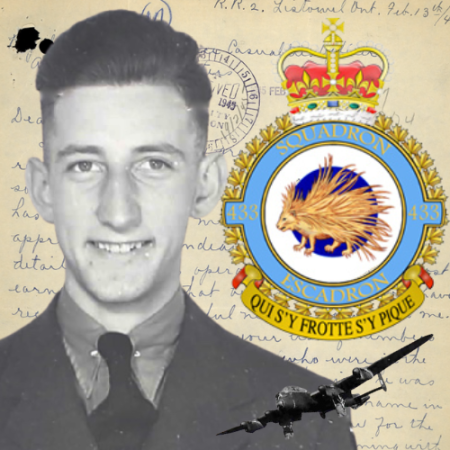
Edward Drew Glass was the son of Edward Murdock Glass, a veteran of the First World War. The father had served in the 48th Highlanders before the First World War, then fought with the 15th Battalion (48th Highlanders) in Flanders. The son followed suit, joining the 48th Highlanders in 1937 at the age of 16, and got his first civilian job at the Simpsons’ Department Store. In 1939, he left his job and volunteered for overseas service with the 48th, leaving his father and sister behind. His mother had passed away years earlier.
By May 1943, Glass was an acting sergeant and selected for officer training in Canada. His evaluation described him as “a very fine type, splendid experience in the army, straightforward, highly intelligent and definitely the leader type.” He returned to England in May 1944 as a newly trained officer. He was assigned to the CANLOAN program— a Canadian program through which “surplus” officers were “loaned” to British regiments needing combat leaders. Glass joined the 1st Battalion, Gordon Highlanders – the sister regiment of the 48th Highlanders. He went to Normandy in July 1944 as a platoon commander in Dog Company.
On the night of August 14, near the village of Fierville, the Gordons endured an accidental Allied bombing—one of many such tragedies in Normandy. Miraculously, they suffered no casualties. At dawn on August 15, the Gordons continued their advance and cleared German positions around St. Sylvain. As they began to dig in for the night, German aircraft struck. The bombs killed Glass and two other members of Dog Company and wounded twenty more. Glass was buried near St. Sylvain before being moved to the Bretteville-sur-Laize cemetery. His father chose the epitaph: “Gone to join his mother.”
Highlander Roy Andrews
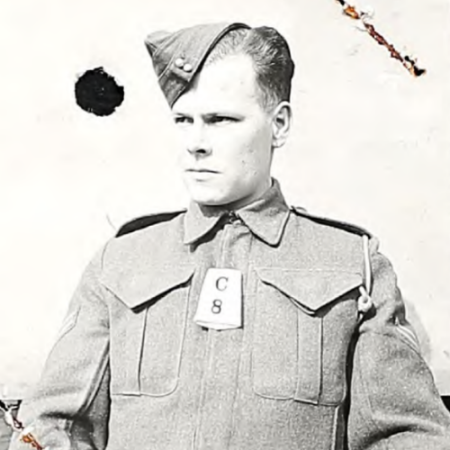
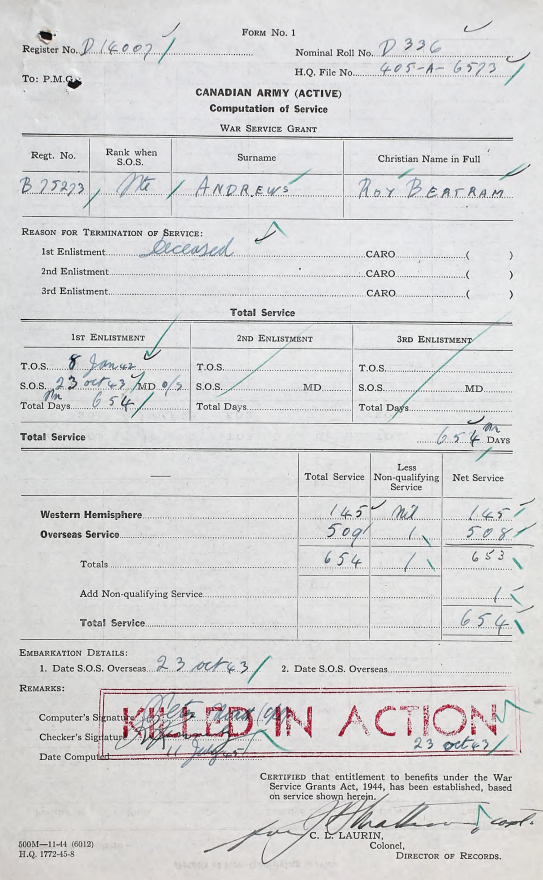
Roy Andrews left school after grade five to support his family—his mother, older sister, and five-year-old brother. His father had abandoned them during the Depression. At fifteen, Andrews began working at Simpsons as a packer. Co-workers remembered him as “clean-cut. Intelligent. Anxious to please.” In January 1942, he volunteered for the army and asked to join the infantry. He chose the 48th Highlanders and sent $40 home to his mother every month—a substantial sum for a private’s pay. After training in Guelph and Borden, he sailed for Britain in June 1942.
A year later, the 48th Highlanders quietly boarded ships for a secret mission. Only after they were at sea did they learn they were bound for Sicily. On July 4, as the vast convoy passed Gibraltar, German U-boats attacked and sank two of the troop-carrying ships. Andrews survived and was taken to Algiers before being assigned to a new ship and rejoining the division. The Canadians landed in Sicily on July 9, 1943. After weeks of hard fighting, they crossed to mainland Italy in September and pushed north. They eventually reached Campobasso, which became an essential Canadian administrative centre. But the town was still within range of German guns. The Highlanders were ordered to clear enemy positions at Torella and first needed to find safe crossing points over the Biferno River.
Andrews was in No. 4 (Scout) Platoon, the battalion’s reconnaissance troops. On the night of October 22, two patrols went out to locate crossing sites. One succeeded. The second never reached the river. Led by Sergeant Midge (Gordon) Major, the second patrol entered a German minefield. Corporal George Ardagh triggered a tripwire mine, which ignited a phosphorous grenade he was carrying. More mines detonated in the chaos. Only Sergeant Major survived. Badly injured, he crawled away, passed out, woke again, and crawled farther until a patrol from The Royal Canadian Regiment found him. When the 48th Highlanders reached the area the next day, they found Highlander Ronald Ward still alive, though he soon died of his wounds. Andrews and the other scouts were all killed.
Initially buried near the Biferno River, Andrews was later moved to the Moro River Cemetery. His mother chose this inscription:
“Oft we see his smiling face
As he bade his last goodbye
And left his home forever
In a distant land to die.”
Remembering the Names and the Monuments
The stories of Lieutenant Glass and Highlander Andrews illustrate the many ways that Canadians served and sacrificed. Lieutenant Glass was one Canadian serving in a British unit, fighting in Normandy while the rest of his regiment fought in Italy. Highlander Andrews was not killed in a large battle, but in a minefield as part of a small reconnaissance patrol. Their names can easily be forgotten, much like the Simpsons Roll of Honour itself. Businesses are acquired and closed; community halls shut down. Memorials can be lost or fall into disrepair, but each of the 52 names on that Roll of Honour deserve to be remembered.
Guest written by Tyler Wentzell for Honouring Bravery