On April 17, 2002, members of the 3rd Battalion, Prince Patricia’s Canada Light Infantry (3 PPCLI) were engaged in night operations at Tarnak Farms, a former Al-Qaeda training camp, just south of Kandahar City. The Patricia’s were undergoing ongoing training to increase their readiness for their role in Afghanistan. That night they were conducting machine gun and anti- tank weapon practice. Master Corporal C. Hollister’s team of Corporal A. Dyer and Private N. Smith had just finished firing their belt-feed heavy machine gun and had begun to gather their equipment to return to base. Off in both directions, members of their unit were also concluding their exercise and firing at their last targets.
Overhead that night were two F-16s piloted by Illinois Air National Guardsman Major W. Umbach and Major J. Schmidt. Schmidt spotted the firing and requested permission from his Airborne Warning and Control System (AWAC) controller to engage the ground targets. He was ordered to ‘hold fire’. Observing the plume of an anti-tank rocket, Schmidt reported he was taking fire from the ground and rolled in to attack the target. Twenty-two seconds after announcing ‘bombs away’, his laser-guided 500-pound munition detonated at the Farms. Ten seconds later, the controller ordered him to disengage, saying that there were friendlies in the area. However, the bomb had done its damage and as a result, four soldiers were killed. A further eight were wounded. Canada was plunged into mourning and disbelief. Her first casualties of the war had been at the hands of her allies.
Killed:
- Sergeant Marc Daniel Léger
- Corporal Ainsworth Dyer
- Private Richard Green
- Private Nathan Lloyd Smith
Wounded:
- Sergeant Lorne Ford
- Master Corporal Curtis Hollister
- Master Corporal Stan Clark
- Corporal René Paquette
- Corporal Brett Perry
- Corporal Brian Decaire
- Corporal Shane Brennan
- Private Norman Link
We are all aware that those who go to war face the risk of being killed or wounded by our enemies. We do not, however, expect them to die in training, vehicle rollovers, electrocutions or swimming accidents. These accidental deaths are somehow all the more bewildering. Yet more shocking is something the military refers to as Blue on Blue. Because in military mapping exercises it is traditional to mark the enemy in red and your own forces in blue, this phrase denotes when your military engages itself. There is a long history of this kind of tragedy. In World War II, during the battle of Normandy, US bombers attacked what they believed to be German formations, but ended up killing 160 Canadian and Polish soldiers. Again during the first Gulf War, 35 Americans were killed by their own forces. Now it had happened again in Afghanistan.
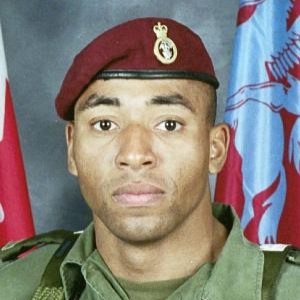
One of those fine young soldiers killed that day was Corporal Ainsworth ‘Ains’ Dyer. He was born in 1977 to Jamaican immigrants, Paul and Agatha Dyer. After his parents separated, he grew up in Toronto, where he was raised by his father and his no-nonsense grandmother. As a very young child, he announced his intention to become a soldier. Since the Great War, young men from the British West Indies have served in Canada’s military. Dyer followed in this distinguished tradition of Black service. In February 1996, while still attending Riverdale Collegiate Institute in the Regent Park area of Toronto, he joined the 48th Highlanders of Canada, a Primary Reserve infantry regiment. After earning his high school diploma, he applied to the Regular forces and joined them in October 1997. After the completion of his Battle School, he was assigned to the 3 PPCLI, the second most senior infantry unit in the Canadian military. Strong, 6’4” and athletic, he was a good soldier who sought out challenges. This is reflected in his official photo, in which he is wearing paratrooper equipment; training not for the faint of heart. He was deployed for the first time as part of the Canadian Peacekeeping efforts in Bosnia-Herzegovina as part of Operation Palladium in 2000. A large man with a big personality, he was known for his humour and loud laugh. Tough and determined, he competed in the military Mountain Man competition. This team endurance race bears some resemblance to a triathlon, with a variety of components: long-distance marches, canoe portages, river paddling and sprints covering upwards of 50 kilometres. It is intended to push the team members to their limits and beyond. Another important element of his life was his faith. He was a committed member of the Church of Christ of Latter-Day Saints, and he was especially popular among the Sunday School children. He met his fiancée, Jocelyn, through his church. He proposed to her just before he deployed, with the intention of being married on his return. Tragically, their future was cut short by a US bomb. Only 24 years old when he died, Dyer was survived by his fiancée, Jocelyn Van Sloten, his father, his mother and his sister Carolyn. His mother Agatha Dawkins was the 2004 National Silver Cross Mother.
Ainsworth Dyer’s death was unnecessary and tragic, but he will be remembered by Canadians as a hero. He was posthumously awarded the Sacrifice Medal and the bridge where he proposed to his fiancée in Edmonton, Alberta, now bears his name.
Did you know?
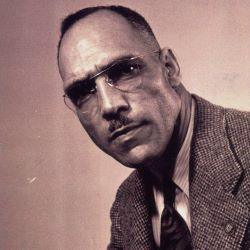
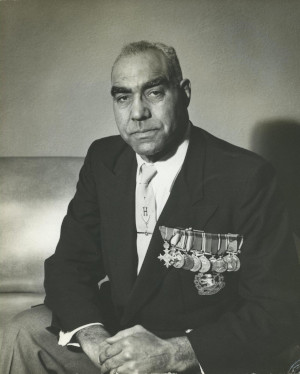
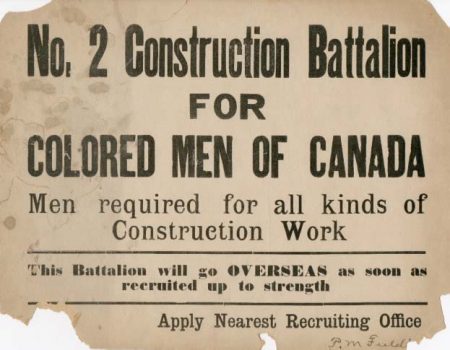
Dyer would not be the first Black Canadian to die on active service. That was Private Charles Green 13637 who died of wounds on April 26, 1915, while serving with the 10th Battalion. Black Canadians and other minorities have consistently and repeatedly answered their nation’s call, even in the face of discrimination. Canadian historian Kathy Grant believes that over 1400 Black men served for Canada in the Great War, with approximately 600 serving in the segregated No. 2 Construction Battalion. In World War Two, the Canadian army would be integrated, though it would take the RCN until 1943 to allow Black enrolment.
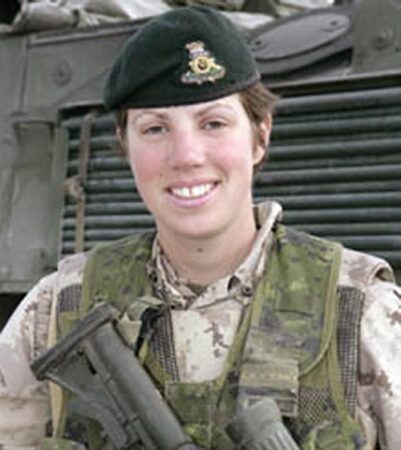
Canadian society has become a much more diverse, open and welcoming society in the past few decades, and our Canadian Armed Forces reflect that change. The 40,000 Canadians who deployed and the 159 Canadian military casualties during the War in Afghanistan include men and women, and people of many descents. Nicola Goddard, Ains Dyer, Michael Yuki Hayakaze, and others are emblematic of Canada’s evolution since 1867.
Written by Kris Tozer for Honouring Bravery.
Cover image: Ainsworth Dyer (Canadian Virtual War Memorial).
Works Consulted
Black Canadian Veterans Stories. “James Munroe Franklin.” James Munroe Franklin, Black Canadian Veterans Stories, 22 June 2025, https://www.blackcanadianveterans.com/post/james-munroe-franklin. Accessed 22 January 2025.
CBC News. “The fog of war: Casualties of friendly fire.” INDEPTH: FRIENDLY FIRE, www.cbc.ca, 22 October 2003, https://www.cbc.ca/news2/background/friendlyfire/fogofwar.html. Accessed 22 January 2026.
CBC News. “Who they were.” Indepth: Friendly fire, CBC, 22 October 2003, https://www.cbc.ca/news2/background/friendlyfire/whotheywere.html. Accessed 22 January 2026.
Humphreys, Adrian. “The U.S. bombed these Canadians in Afghanistan. This is their story.” National Post, 10 November 2022, https://nationalpost.com/news/canada/remembrance-day-tarnak-farm-afghanistan. Accessed 22 January 2026.
“No. 2 Construction Battalion: The Black Battalion.” No. 2 Construction, Black Canadian Veterans Stories, 2025, https://www.no2constructionbattalion.ca/. Accessed 22 January 2026.
Smith, Bryan. “Harry Schmidt’s War.” Chicago Magazine, Chicago Magazine, 25 June 2007, https://www.chicagomag.com/chicago-magazine/april-2005/harry-schmidts-war/. Accessed 20 January 2026.